
Review the key concepts, formulae, and examples before starting your quiz.
🔑Concepts
The slope-intercept form of a linear equation is , where represents the gradient (slope) and represents the -intercept. Lines that never intersect and are always the same distance apart are called parallel lines.
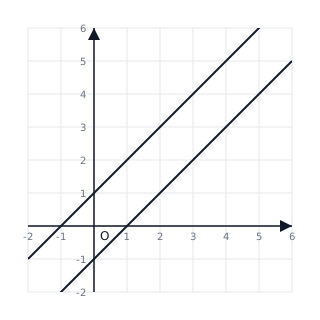
Parallel lines have the exact same gradient. If line has gradient and line has gradient , then implies .
Perpendicular lines intersect at a right angle (). The product of the gradients of two perpendicular lines is always . This is expressed as or .
To find the equation of a new line, first identify the gradient of the reference line, apply the parallel/perpendicular rule to find the new gradient , then use the point-slope formula with the given coordinates.
📐Formulae
💡Examples
Problem 1:
Find the equation of the line that is parallel to and passes through the point .
Solution:
- Identify the gradient of the given line: .
- Since the lines are parallel, the new line also has .
- Use the point-slope form: .
- Expand and simplify:
Explanation:
Parallel lines share the same slope. By identifying the slope from the given equation and substituting the coordinates of the point into the line equation, we find the specific -intercept for the new line.
Problem 2:
Find the equation of the line perpendicular to that passes through the point .
Solution:
- Identify the gradient of the given line: .
- Find the perpendicular gradient: .
- Use the slope-intercept form with the point :
- The equation is .
Explanation:
Perpendicular gradients are negative reciprocals. We flip the fraction and change the sign of the original slope to get , then solve for the -intercept using the provided point.
Problem 3:
Determine if the line passing through and is perpendicular to the line .
Solution:
- Calculate the gradient of the first line ():
- Identify the gradient of the second line: .
- Multiply the gradients:
- Since the product is , the lines are perpendicular.
Explanation:
By calculating the slope between two points and comparing it to the slope of the second equation, we use the property to confirm perpendicularity.
Problem 4:
Find the equation of the line that is parallel to the line passing through and and passes through the point .
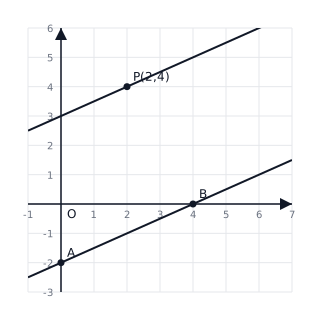
Solution:
- Find the gradient of line :
- Since the new line is parallel, its gradient is also .
- Use the point in the equation :
Explanation:
Parallel lines share the same slope. By calculating the slope between the two given points, we define the slope for our target line and then substitute the specific point into the linear equation formula.
Problem 5:
Find the equation of the line that passes through the point and is perpendicular to the line . Express your final answer in the form .
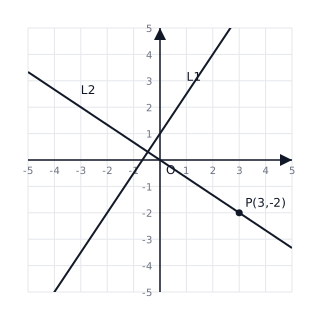
Solution:
-
Identify the gradient of the given line:
-
Determine the gradient of the perpendicular line (): Since the lines are perpendicular,
-
Use the point-gradient formula with the point :
-
Solve for :
Explanation:
To find a perpendicular line, we use the property that the product of their gradients is . Once the new gradient is found, we substitute the given coordinates into the linear equation formula to find the specific value (y-intercept).