
Review the key concepts, formulae, and examples before starting your quiz.
🔑Concepts
A Function is a special relationship where each input (from the domain) is paired with exactly one output (in the range). If an input maps to multiple outputs, it is not a function.
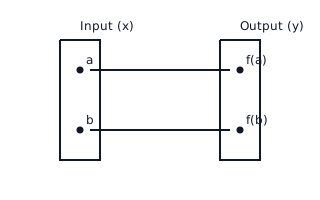
Mapping Notation: We use to denote that the function maps the input to the expression . This is equivalent to writing .
Domain: The set of all possible input values (-values) for which the function is defined.
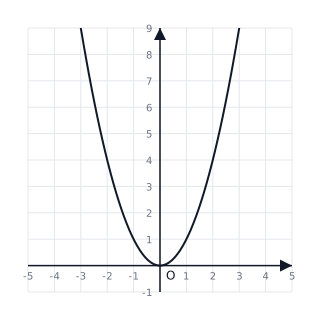
Range: The set of all possible output values (-values) resulting from the domain values.
Vertical Line Test: A curve in the coordinate plane is a function of if and only if no vertical line intersects the curve more than once.
📐Formulae
💡Examples
Problem 1:
Given the function , find the value of .
Solution:
Explanation:
Substitute the value into the function expression and follow the order of operations (BODMAS/BIDMAS).
Problem 2:
A function is defined by . Find the range for the domain .
Solution:
For : For : For :
Explanation:
To find the range, substitute each element of the domain into the mapping rule to find the corresponding outputs.
Problem 3:
Identify the domain and range from the set of ordered pairs: .
Solution:
Explanation:
In a set of ordered pairs , the domain consists of all the first coordinates (), and the range consists of all the second coordinates ().
Problem 4:
Given the function with domain , determine the range and sketch the mapping.
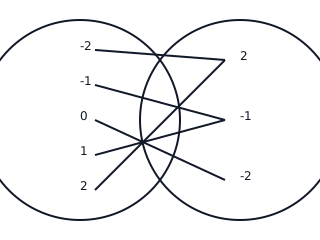
Solution:
Range:
Explanation:
To find the range, substitute each element of the domain into the function. Note that even though the domain has 5 elements, the range only has 3 because some outputs are repeated.
Problem 5:
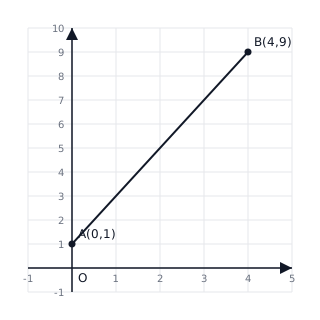
Determine the domain and range of the linear function shown on the coordinate plane for the interval .
Solution:
From the graph: Minimum , Maximum . Domain: . Minimum . Maximum . Range: .
Explanation:
For a continuous function on a closed interval, the range is determined by finding the outputs of the minimum and maximum domain values.