
Review the key concepts, formulae, and examples before starting your quiz.
🔑Concepts
An exponential function is of the form . The constant represents the vertical shift and dictates the position of the horizontal asymptote, which is the line . The graph approaches this line but never crosses or touches it.
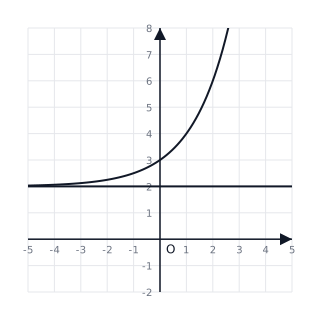
The base determines the behavior: if , the function shows exponential growth (increases rapidly); if , it shows exponential decay (decreases toward the asymptote).
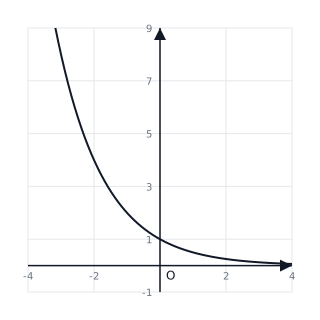
The value of affects the -intercept. For , the -intercept is found by setting , resulting in , or the point .
Domain and Range: For any exponential function where , the domain is all real numbers () and the range is .
📐Formulae
💡Examples
Problem 1:
Identify the horizontal asymptote and the -intercept for the function .
Solution:
Horizontal Asymptote: ; -intercept: .
Explanation:
Comparing to the general form , we see that . Therefore, the horizontal asymptote is . To find the -intercept, we substitute : . Thus, the intercept is at the point .
Problem 2:
Determine if the function represents growth or decay, and state its horizontal asymptote.
Solution:
The function represents exponential decay; Horizontal Asymptote: .
Explanation:
Since the base is between and (), the function represents exponential decay. The constant term is , which means the graph approaches the line as increases.
Problem 3:
Given the function , find the value of when and state the equation of the horizontal asymptote.
Solution:
; Horizontal Asymptote: .
Explanation:
To find , substitute into the equation: . The horizontal asymptote is determined by the constant term , so the equation is .
Problem 4:
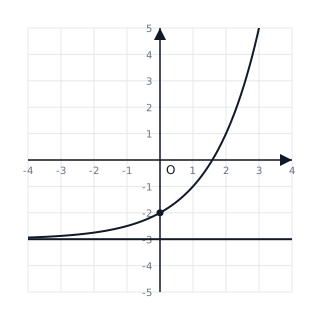
Graph the function . Identify its -intercept and the equation of its horizontal asymptote.
Solution:
- Identify : Here, . The horizontal asymptote is .
- Find the -intercept: Set . . The -intercept is .
- Behavior: Since and , the function is increasing (growth).
Explanation:
The graph shifts 3 units down from the parent function , moving the asymptote from to .
Problem 5:
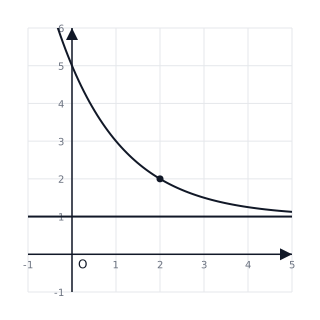
Consider the function . Determine the range of the function and the value of .
Solution:
- Range: Since (positive) and , the function stays above the asymptote. Range: .
- Calculate : .
Explanation:
Because the base is , the function decays toward the horizontal line . At , the value is exactly .