
Review the key concepts, formulae, and examples before starting your quiz.
🔑Concepts
The fundamental property of any triangle is that the sum of the lengths of any two sides must be strictly greater than the length of the third side. For a triangle with sides , , and , we must satisfy: , , and .
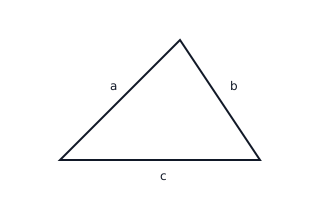
If the sum of two sides is equal to the third side (), the 'triangle' collapses into a straight line, and no actual triangle is formed. If the sum is less than the third side, the ends of the two shorter sides cannot meet.
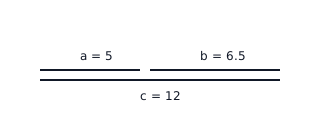
The difference between the lengths of any two sides of a triangle is always smaller than the length of the third side: .
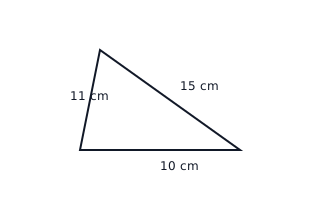
To determine if three given lengths can form a triangle, it is sufficient to check if the sum of the two smaller lengths is greater than the largest length.
📐Formulae
💡Examples
Problem 1:
Check if a triangle can be formed with side lengths 8 cm, 10 cm, and 15 cm.
Solution:
Step 1: Identify the side lengths as , , and . Step 2: Test all three sum conditions:
- . Is ? Yes.
- . Is ? Yes.
- . Is ? Yes. Since the sum of any two sides is greater than the third side in all cases, a triangle can be formed.
Explanation:
To determine if a triangle is possible, we verify the Triangle Inequality Theorem by checking if every combination of two sides added together exceeds the third side.
Problem 2:
The lengths of two sides of a triangle are 6 cm and 9 cm. Between which two numbers must the length of the third side fall?
Solution:
Step 1: Let the two given sides be cm and cm. Step 2: Calculate the sum of the sides: cm. The third side must be less than 15 cm. Step 3: Calculate the difference of the sides: cm. The third side must be greater than 3 cm. Therefore, the third side must satisfy .
Explanation:
The third side of a triangle is always bounded by the difference and the sum of the other two sides. Any value strictly between 3 and 15 (like 4, 7, or 14.5) would allow a triangle to be constructed.
Problem 3:
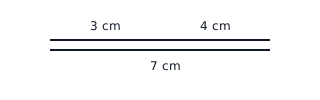
Is it possible to have a triangle with sides cm, cm, and cm?
Solution:
Since the sum of the two shorter sides is not greater than the third side ( cm), a triangle cannot be formed.
Explanation:
According to the Triangle Inequality Theorem, the sum of any two sides must be greater than the third side. Here, is equal to , not greater than .
Problem 4:
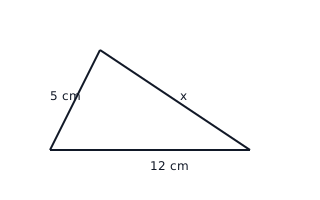
A triangle has sides of cm and cm. If the third side is an integer, what are the minimum and maximum possible values for ?
Solution:
Minimum value: . The smallest integer greater than is . Maximum value: . The largest integer less than is .
Explanation:
The third side must be greater than the difference of the two sides () and smaller than the sum of the two sides ().