
Review the key concepts, formulae, and examples before starting your quiz.
🔑Concepts
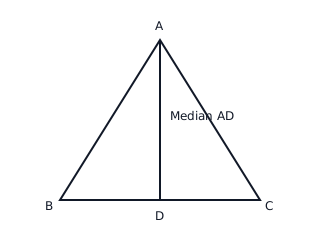
A median of a triangle is a line segment connecting a vertex to the midpoint of the opposite side. Every triangle has exactly three medians, which all intersect at a single point called the centroid.
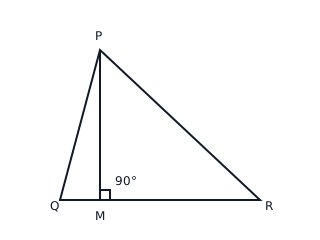
An altitude of a triangle is the perpendicular segment from a vertex to the line containing the opposite side. The length of the altitude is the height of the triangle. The three altitudes intersect at a point called the orthocenter.
In an isosceles triangle, the median and altitude from the vertex (joining the equal sides) to the base are the same line segment. In an equilateral triangle, all medians are also altitudes.
Altitudes can lie inside or outside the triangle. In an obtuse-angled triangle, two of the altitudes lie outside the triangle, while in a right-angled triangle, the two legs themselves act as altitudes.
📐Formulae
💡Examples
Problem 1:
In , is the median to the side . If the length of is , find the length of .
Solution:
- Understand that a median connects a vertex to the midpoint of the opposite side. Since is the median, is the midpoint of .
- By the property of medians, .
- Substitute the given value: .
- .
Explanation:
Because the median bisects the side it is drawn to, we simply divide the total length of side by 2 to find the length of the segment .
Problem 2:
Find the area of a triangle where the base is and the corresponding altitude is .
Solution:
- Use the area formula: .
- Substitute the given dimensions: .
- Perform the calculation: .
- The final area is .
Explanation:
The altitude of a triangle acts as its height. By multiplying the base by the altitude and then taking half of that product, we determine the total space enclosed by the triangle.
Problem 3:
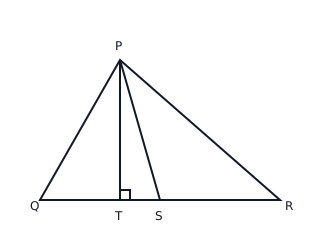
In , is the midpoint of . Name the line segments and if is perpendicular to .
Solution:
- Since is the midpoint of the side and it is connected to the opposite vertex , the segment is the median.
- Since is perpendicular to (indicated by the angle), the segment is the altitude.
Explanation:
By definition, a median joins a vertex to the midpoint of the opposite side, while an altitude is the perpendicular distance from a vertex to the opposite side.
Problem 4:
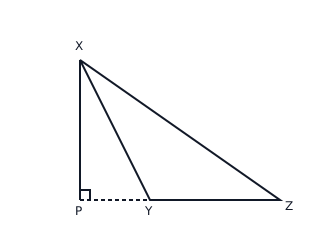
Given an obtuse-angled triangle where , draw the altitude from vertex to the side . Does it lie inside the triangle?
Solution:
- To draw the altitude from , we must extend the side to a point outside the triangle.
- We then draw a perpendicular from to the line .
- The segment is the altitude. It lies outside the triangle.
Explanation:
In obtuse triangles, altitudes from the acute-angled vertices fall on the extension of the opposite sides and thus lie in the exterior of the triangle.