
Review the key concepts, formulae, and examples before starting your quiz.
🔑Concepts
The Angle Sum Property states that the sum of all internal angles in any triangle is always exactly .
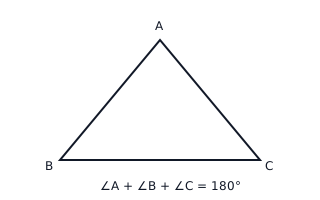
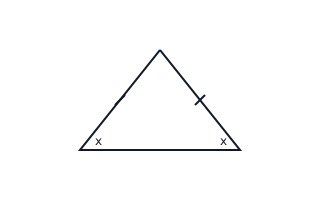
In an isosceles triangle, the angles opposite to the equal sides are equal. If we know the vertex angle, we can find the base angles using the angle sum property.
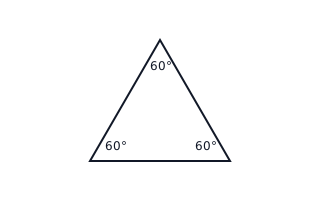
In an equilateral triangle, all three angles are equal. Since the sum is , each angle must be because .
The angle sum property helps in finding an unknown angle when two angles are given, or when a relationship between the angles is known (like a ratio).
📐Formulae
💡Examples
Problem 1:
In , the measure of and the measure of . Find the measure of .
Solution:
- According to the Angle Sum Property, .
- Substitute the given values into the equation: .
- Calculate the sum of the known angles: .
- Subtract from both sides to find the unknown angle: .
- Final result: .
Explanation:
To find a missing angle in a triangle, we subtract the sum of the two known angles from .
Problem 2:
One of the acute angles of a right-angled triangle is . Find the measure of the other acute angle.
Solution:
- In a right-angled triangle, one angle is always . Let the three angles be , , and .
- Use the Angle Sum Property: .
- Simplify the equation: .
- Solve for : .
- Final result: .
Explanation:
Since one angle is fixed at , the other two angles must add up to . We can simply subtract the given acute angle from to find the answer: .
Problem 3:
The angles of a triangle are in the ratio . Find the measure of each angle of the triangle.
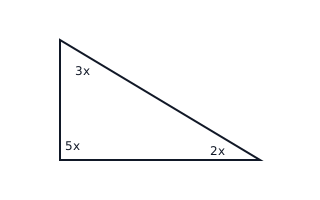
Solution:
Let the angles be , , and . By Angle Sum Property: Now, find each angle: Angle 1 = Angle 2 = Angle 3 =
Explanation:
We use the ratio to represent angles as multiples of a common variable . Their sum is equated to to solve for .
Problem 4:
In , and . Find all three angles.
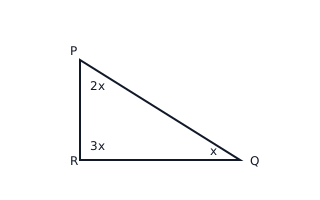
Solution:
Let . Then, and . By the Angle Sum Property: So,
Explanation:
By expressing all angles in terms of , we create a linear equation based on the angle sum property.