
Review the key concepts, formulae, and examples before starting your quiz.
🔑Concepts
A right-angled triangle is a triangle in which one of the angles is exactly . The side opposite to the right angle is the longest side and is called the hypotenuse. The other two sides are known as the legs or the base and the perpendicular.
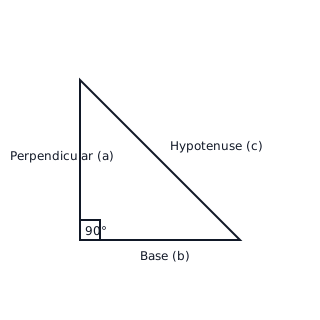
The Pythagoras Property states that in a right-angled triangle, the square of the hypotenuse is equal to the sum of the squares of the other two sides. Formula: .
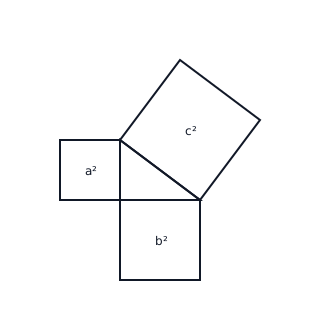
Pythagorean Triplets are sets of three positive integers that satisfy the rule . Examples include , , and .
The Converse of Pythagoras Property: If a triangle's sides satisfy the relation , then the triangle must be right-angled, with the right angle opposite to the side .
📐Formulae
Pythagoras Theorem:
Calculating the Hypotenuse:
Calculating a Leg: or
Condition for Right-angled Triangle:
💡Examples
Problem 1:
Find the length of the hypotenuse of a right-angled triangle whose legs are and long.
Solution:
- Let the legs be and . Let the hypotenuse be .
- According to Pythagoras Property:
- Substitute the values:
- Calculate the squares:
- Add the values:
- Find the square root: .
Explanation:
We use the standard Pythagoras formula where the sum of the squares of the two shorter sides gives the square of the longest side (hypotenuse).
Problem 2:
A long ladder is placed against a wall such that its foot is away from the wall. At what height does the ladder reach the wall?
Solution:
- Here, the ladder acts as the hypotenuse () and the distance from the wall is the base ().
- We need to find the height ().
- Using , we get:
- Subtract from both sides:
- .
Explanation:
This is a real-world application of the Pythagoras property where the wall, the ground, and the ladder form a right-angled triangle. We solve for the missing leg (the height on the wall).
Problem 3:
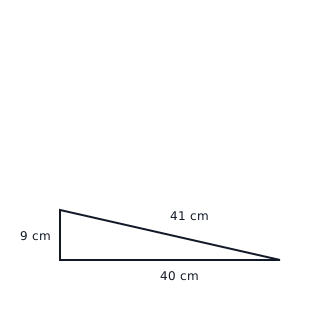
Determine if a triangle with side lengths , , and is a right-angled triangle.
Solution:
- Identify the longest side: .
- Calculate : .
- Identify the other two sides: .
- Calculate : .
- Since (), the triangle is right-angled.
Explanation:
According to the converse of the Pythagoras property, if the sum of squares of two sides equals the square of the third side, the triangle is right-angled.
Problem 4:
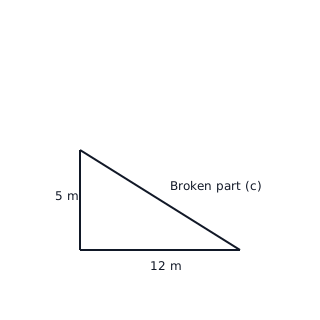
A tree is broken at a height of from the ground and its top touches the ground at a distance of from the base of the tree. Find the original height of the tree.
Solution:
- Let the broken part of the tree be the hypotenuse .
- The vertical part is , and the distance to the base is .
- By Pythagoras property: .
- .
- Original height = Broken part + Vertical part = .
Explanation:
The broken tree forms a right-angled triangle. We find the length of the fallen part using Pythagoras theorem and add it to the standing height.