
Review the key concepts, formulae, and examples before starting your quiz.
🔑Concepts
An exterior angle of a triangle is formed when a side of the triangle is extended beyond its vertex. For every triangle, there are six possible exterior angles (two at each vertex).
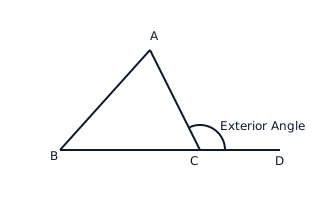
The measure of an exterior angle of a triangle is equal to the sum of its two interior opposite angles. This is known as the Exterior Angle Property of a triangle.
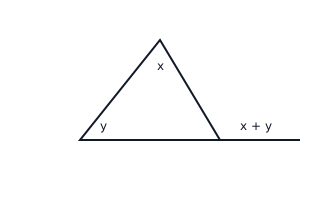
An exterior angle and its adjacent interior angle form a linear pair, meaning their sum is always .
The exterior angle is always greater than either of its interior opposite angles.
📐Formulae
💡Examples
Problem 1:
In triangle , side is produced to . If interior angles and , find the measure of the exterior angle .
Solution:
- Identify the interior opposite angles relative to , which are and .
- Apply the Exterior Angle Property: .
- Substitute the given values: .
- Calculate the sum: .
Explanation:
According to the property, an exterior angle equals the sum of its two interior opposite angles. By adding the two given interior angles, we find the exterior angle.
Problem 2:
An exterior angle of a triangle measures . If one of the interior opposite angles is , find the measure of the other interior opposite angle.
Solution:
- Let the unknown interior opposite angle be .
- Use the formula: .
- Set up the equation: .
- Solve for : .
- .
Explanation:
We use the Exterior Angle Property in reverse. Since the sum of the interior opposite angles must equal the exterior angle, we subtract the known interior angle from the exterior angle to find the missing one.
Problem 3:
In the given figure, find the value of the unknown interior angle if the exterior angle is and one interior opposite angle is .
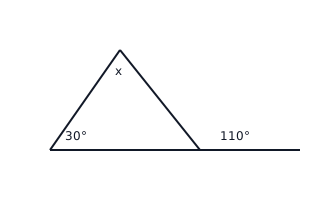
Solution:
- According to the Exterior Angle Property:
- Substitute the given values:
- Solve for :
Explanation:
The exterior angle of must equal the sum of the non-adjacent interior angles ( and ). By subtracting the known interior angle from the exterior angle, we find .
Problem 4:
Find the value of in the following triangle where the interior opposite angles are and , and the exterior angle is .
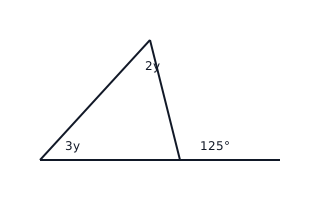
Solution:
- Using the Exterior Angle Property:
- Combine like terms:
- Divide by 5:
Explanation:
Since the sum of the interior opposite angles equals the exterior angle, we set up an algebraic equation to solve for the variable .