
Review the key concepts, formulae, and examples before starting your quiz.
🔑Concepts
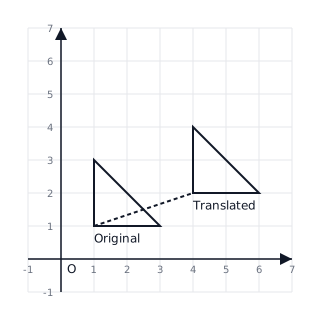
A translation slides a shape in a specific direction for a specific distance without rotating or flipping it. We describe the movement as horizontal (along the x-axis) and vertical (along the y-axis). The rule is written as . For example, a translation of 2 units right and 3 units up transforms to .
A reflection creates a mirror image of a shape across a line called the mirror line or axis of reflection. Every point on the image is the same distance from the mirror line as the corresponding point on the original shape. When reflecting over the x-axis, the y-coordinate changes sign: . When reflecting over the y-axis, the x-coordinate changes sign: .
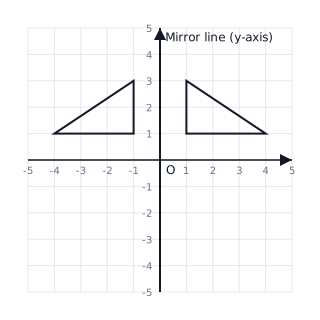
In both translations and reflections, the original shape and the resulting image are congruent. This means they have the exact same size and shape, even if their position or orientation has changed.
To perform a reflection across an arbitrary horizontal or vertical line like or , count the perpendicular distance from each vertex to the line, then count the same distance on the opposite side to plot the image points.
📐Formulae
Translation Rule: where is the horizontal shift and is the vertical shift.
Reflection over the x-axis:
Reflection over the y-axis:
💡Examples
Problem 1:
A triangle has a vertex at . If the triangle is translated 3 units to the right and 2 units down, what are the new coordinates of ?
Solution:
Explanation:
To move 3 units right, add 3 to the x-coordinate: . To move 2 units down, subtract 2 from the y-coordinate: .
Problem 2:
Reflect the point across the x-axis. What are the coordinates of the image ?
Solution:
Explanation:
When reflecting across the x-axis, the x-coordinate remains the same, but the y-coordinate changes its sign (multiplied by -1).
Problem 3:
A square is reflected across a vertical mirror line . If a vertex of the square is at , what is the x-coordinate of the reflected vertex?
Solution:
Explanation:
The original vertex is 3 units away from the mirror line (). The reflected image must also be 3 units away on the other side: .
Problem 4:
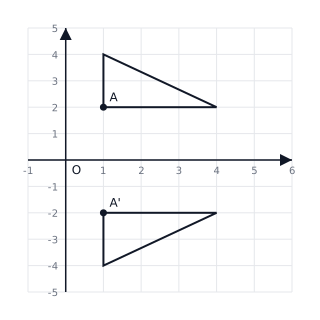
A triangle has vertices at , , and . Reflect this triangle over the x-axis. What are the coordinates of the vertices of the image ?
Solution:
The image coordinates are , , and .
Explanation:
To reflect a point over the x-axis, the x-coordinate stays the same while the y-coordinate is multiplied by . For instance, moves from units above the x-axis to units below it at .
Problem 5:
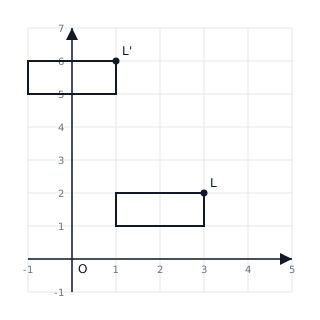
A rectangle has vertices at , , , and . Apply a translation that moves the rectangle 2 units left and 4 units up. Find the new coordinates of vertex .
Solution:
The translation rule is . For vertex : The new coordinates of are .
Explanation:
Translating '2 units left' means subtracting 2 from the x-coordinate. Translating '4 units up' means adding 4 to the y-coordinate. Applying this to point results in .