
Review the key concepts, formulae, and examples before starting your quiz.
🔑Concepts
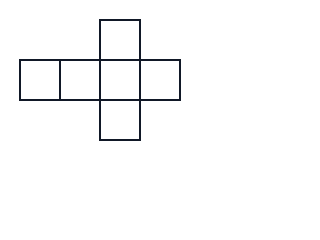
A net is a 2D pattern that can be folded to make a 3D shape. A cube has a net consisting of six equal squares. There are 11 different net configurations for a cube, but the most common is the 'cross' shape.
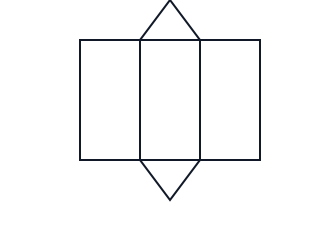
Prisms have a constant cross-section and two identical ends. A triangular prism has two triangular bases and three rectangular lateral faces. Its net typically looks like three rectangles joined in a row with triangles attached to the sides of one rectangle.
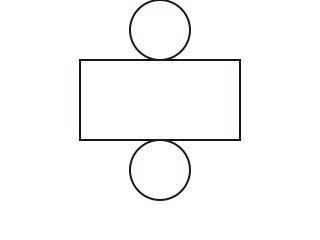
A cylinder consists of two parallel circular bases and a curved surface. When flattened, the curved surface becomes a rectangle, and the net shows two circles attached to the top and bottom of that rectangle.
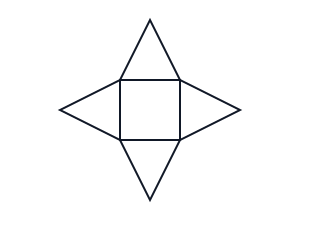
Pyramids have a base (which can be any polygon) and triangular faces that meet at a single point called the apex. A square-based pyramid has a square base and four triangular faces.
📐Formulae
Euler's Formula for Polyhedra: (where = Faces, = Vertices, = Edges)
Cube Properties:
Square-based Pyramid Properties:
Triangular Prism Properties:
💡Examples
Problem 1:
Identify the 3D shape that consists of 2 circular faces and 1 curved surface. What would its net look like?
Solution:
Cylinder.
Explanation:
A cylinder has two identical circular bases at the top and bottom. Its net consists of two circles and one rectangle (which wraps around to form the curved surface).
Problem 2:
A 3D shape has 4 triangular faces and 4 vertices. Name the shape and describe its net.
Solution:
Triangular-based pyramid (or Tetrahedron).
Explanation:
Since all 4 faces are triangles, it is a tetrahedron. Its net consists of four triangles joined together; commonly seen as one central triangle with three other triangles attached to its sides.
Problem 3:
If a shape is a hexagonal prism, how many faces, vertices, and edges does it have?
Solution:
Faces: 8, Vertices: 12, Edges: 18.
Explanation:
A hexagonal prism has 2 hexagonal bases and 6 rectangular side faces (). It has 6 vertices on the top base and 6 on the bottom (). It has 6 edges on the top, 6 on the bottom, and 6 vertical edges connecting them ().
Problem 4:
Which 3D shape has a net made of one square and four triangles?
Solution:
Square-based pyramid.
Explanation:
The square acts as the base of the pyramid, and the four triangles fold up to meet at a single point (vertex) above the center of the square.
Problem 5:
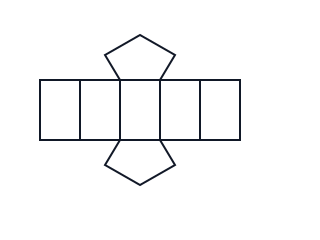
Identify the 3D shape formed by the following net and calculate its total number of edges .
Solution:
Explanation:
The net consists of two pentagonal faces and five rectangular faces. This identifies the shape as a pentagonal prism. For any prism with an -sided base, the number of edges is . Here, , so .
Problem 6:
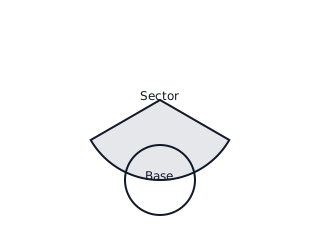
A 3D shape is a cone. Describe the components of its net and identify the shape of the lateral surface.
Solution:
The net of a cone consists of a circle (the base) and a sector of a larger circle (the lateral surface).
Explanation:
When a cone is 'unrolled', the curved surface forms a sector (a pie slice shape). The distance along the arc of this sector must be equal to the circumference of the circular base, .