
Review the key concepts, formulae, and examples before starting your quiz.
🔑Concepts
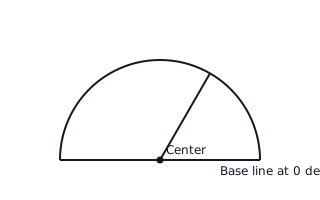
The vertex of the angle must be aligned exactly with the center point of the protractor, and the base line of the angle must align with the line on the scale.
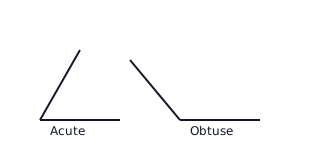
Identify the type of angle before measuring: Acute angles are less than , obtuse angles are between and , and reflex angles are greater than .
Protractors usually have two scales (inner and outer). Use the scale that starts at on the arm of the angle you are measuring from.
To draw an angle, first draw a straight line (the base arm), place the protractor center on the start point, mark the required degree, and join the points.
📐Formulae
💡Examples
Problem 1:
Measure an angle where one arm points to the right-hand '0' and the other arm points towards '75' on the inner scale.
Solution:
Explanation:
Since the baseline of the angle is aligned with the right-hand zero, we follow the inner scale starting from zero up to the line, which reaches 75.
Problem 2:
Identify the type of angle that measures .
Solution:
Obtuse Angle
Explanation:
An angle is classified as obtuse if it is greater than but less than . Since falls in this range, it is obtuse.
Problem 3:
An angle on a straight line is divided into two parts. One part is . Calculate the missing angle.
Solution:
Explanation:
Angles on a straight line add up to . Therefore, the missing angle is .
Problem 4:
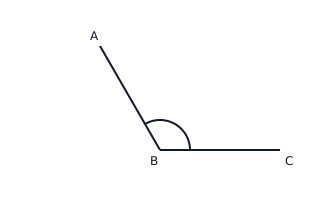
Use a protractor to measure the angle shown in the diagram.
Solution:
The angle measures .
Explanation:
- Place the center of the protractor on vertex .
- Align the base line of the protractor with the line (pointing to on the inner scale).
- Follow the inner scale around to where the line crosses it, which is at .
Problem 5:
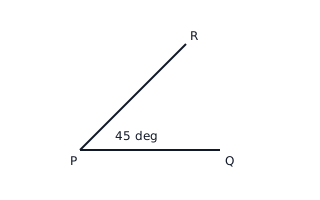
Draw an acute angle of starting from point .
Solution:
An angle of is created between the horizontal base and the newly drawn arm.
Explanation:
- Draw a horizontal line .
- Place the protractor center on .
- Find on the scale and mark a point .
- Connect to with a straight line.