
Review the key concepts, formulae, and examples before starting your quiz.
🔑Concepts
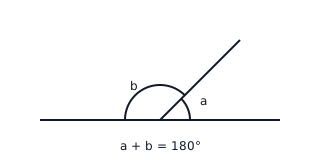
Angles on a straight line always add up to . This is known as the sum of angles on a straight line or supplementary angles.
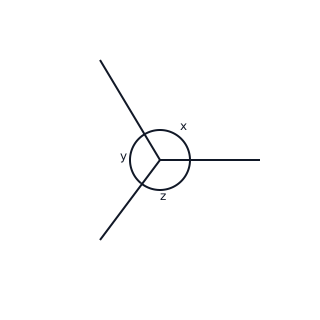
Angles at a point (around a full circle) always add up to .
A right angle is exactly and is usually marked with a small square symbol.
To find a missing angle, subtract the sum of the known angles from the total ( for a line, for a point).
📐Formulae
(for two angles on a straight line)
💡Examples
Problem 1:
A straight line is divided into two angles. One angle is . Find the size of the missing angle .
Solution:
Explanation:
Since angles on a straight line add up to , we calculate .
Problem 2:
Four angles meet at a point. Three of the angles are , , and . Calculate the fourth angle .
Solution:
Explanation:
Angles around a point sum to . First, add the known angles: . Then, subtract from the total: .
Problem 3:
On a straight line, there are three angles: , a right angle, and an unknown angle . Find .
Solution:
Explanation:
A right angle is . The total for a straight line is . So, .
Problem 4:
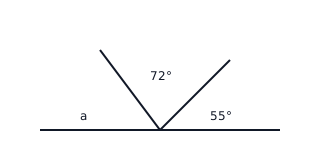
Three angles lie on a straight line. Two of the angles are and . Calculate the value of the third angle .
Solution:
- Sum the known angles:
- Subtract from :
- Therefore, .
Explanation:
Since the angles are on a straight line, their total must be . By subtracting the known values from , we find the remaining angle.
Problem 5:
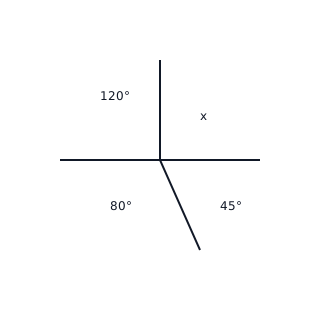
Find the missing angle in the diagram where four angles meet at a point. The known angles are , , and .
Solution:
- Sum the known angles:
- Subtract the sum from :
- So, .
Explanation:
The sum of all angles around a point is . Adding the three given angles gives . Subtracting this from leaves for the missing angle.