
Review the key concepts, formulae, and examples before starting your quiz.
🔑Concepts
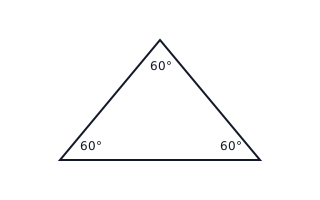
Triangles are classified by their sides and angles. An Equilateral triangle has three equal sides and three equal angles of , while an Isosceles triangle has at least two equal sides and two equal base angles.
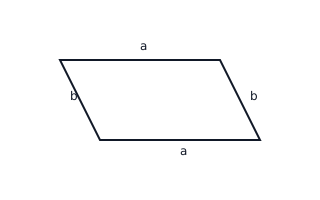
Quadrilaterals are 4-sided polygons where the sum of interior angles is always . Common types include Parallelograms (opposite sides parallel and equal), Rhombuses (all sides equal), and Trapeziums (one pair of parallel sides).
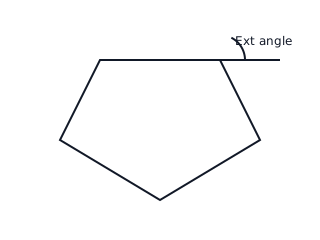
A Regular Polygon has all sides of equal length and all interior angles of equal size. The exterior angle and the interior angle at any vertex always lie on a straight line and sum to .
The sum of exterior angles of any convex polygon is always , regardless of the number of sides.
📐Formulae
Sum of interior angles in any triangle =
Sum of interior angles in any quadrilateral =
Sum of interior angles in an -sided polygon =
Interior angle of a regular -sided polygon =
💡Examples
Problem 1:
An isosceles triangle has one angle of at its apex (the angle between the two equal sides). Calculate the size of the other two angles.
Solution:
each
Explanation:
Since the triangle is isosceles, the two base angles are equal. The sum of angles is . Subtract the apex angle: . Divide by 2 for the two equal angles: .
Problem 2:
A quadrilateral has three angles measuring , , and . Find the value of the fourth angle.
Solution:
Explanation:
The sum of angles in a quadrilateral is . Add the known angles: . Subtract from the total: .
Problem 3:
What is the sum of the interior angles of a regular Hexagon?
Solution:
Explanation:
A hexagon has sides. Using the formula , we get .
Problem 4:
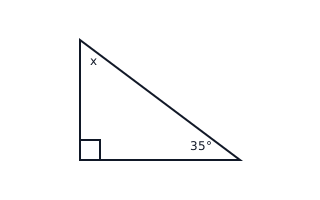
Find the size of the missing angle in the right-angled triangle shown below.
Solution:
- We know the sum of angles in a triangle is .
- The square symbol indicates a right angle, which is .
- The given angle is .
- The missing angle is .
Explanation:
In any right-angled triangle, the two non-right angles are complementary, meaning they must add up to .
Problem 5:
Calculate the size of one interior angle of a regular octagon (an 8-sided polygon).
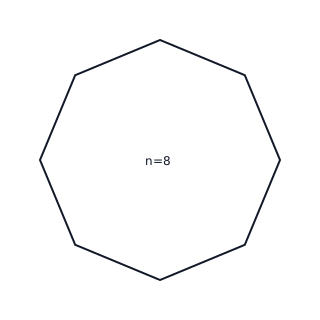
Solution:
- Use the formula for the sum of interior angles: .
- For an octagon, .
- .
- Since it is a regular polygon, divide the sum by the number of angles:
- . Each interior angle is .
Explanation:
A regular polygon has all equal angles. Alternatively, you can find the exterior angle first () and subtract from .