
Review the key concepts, formulae, and examples before starting your quiz.
🔑Concepts
The coordinate plane is divided into four regions called quadrants by the horizontal -axis and the vertical -axis. The point where they intersect is the origin . Each point is described by an ordered pair . In Quadrant I, both coordinates are positive; in Quadrant II, is negative and is positive; in Quadrant III, both are negative; and in Quadrant IV, is positive and is negative.
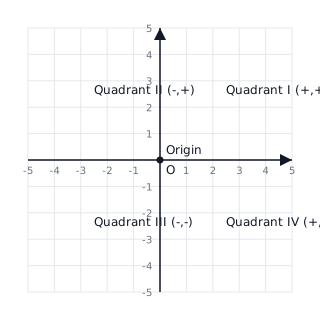
Plotting points involves moving horizontally from the origin according to the -coordinate (right for positive, left for negative) and then vertically according to the -coordinate (up for positive, down for negative).
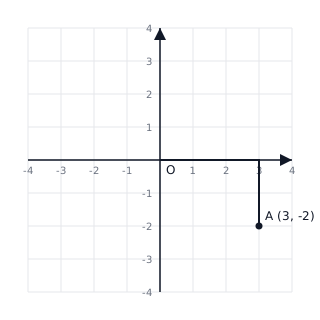
Geometric shapes can be represented on the coordinate plane by connecting vertices. For instance, a rectangle can be defined by four points where opposite sides are parallel to the axes.
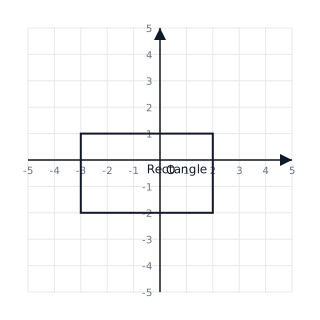
Reflections across the axes change the sign of the coordinates. Reflecting across the -axis results in . Reflecting across the -axis results in .
📐Formulae
Ordered Pair:
Midpoint of a line segment:
Translation (Moving a point): where 'a' is horizontal shift and 'b' is vertical shift.
Horizontal Distance between and : (when y-coordinates are the same).
Vertical Distance between and : (when x-coordinates are the same).
💡Examples
Problem 1:
Identify the quadrant in which the point lies.
Solution:
Quadrant II
Explanation:
The x-coordinate is negative (-4) and the y-coordinate is positive (3). In the coordinate plane, negative x and positive y values are located in the top-left section, which is Quadrant II.
Problem 2:
A square has three vertices at , , and . Find the coordinates of the fourth vertex .
Solution:
Explanation:
In a square, opposite sides are parallel and equal in length. Points A and B are on the line . Points B and C are on the line . To complete the square, point D must align horizontally with C () and vertically with A (). Therefore, the point is .
Problem 3:
Translate the point by 4 units to the left and 2 units up. What are the new coordinates?
Solution:
Explanation:
Moving 4 units left means subtracting 4 from the x-coordinate: . Moving 2 units up means adding 2 to the y-coordinate: . The resulting coordinate is .
Problem 4:
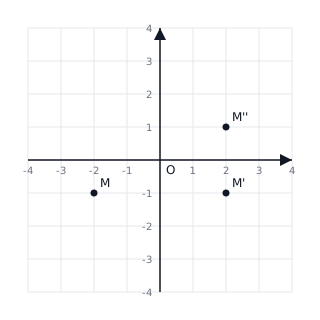
Point is located at . Reflect this point across the -axis to get point . Then, reflect across the -axis to get point . State the coordinates of and .
Solution:
Explanation:
To reflect across the -axis, change the sign of the -coordinate: . To reflect across the -axis, change the sign of the -coordinate: .
Problem 5:
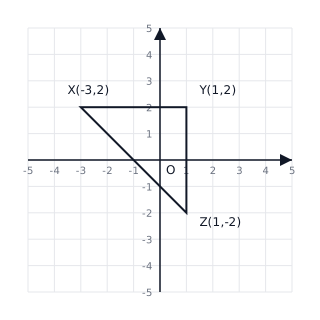
A right-angled triangle has vertices at , , and . Calculate the lengths of the horizontal and vertical sides.
Solution:
Explanation:
The side is horizontal because the -coordinates are the same; its length is the difference in -values. The side is vertical because the -coordinates are the same; its length is the difference in -values.