
Review the key concepts, formulae, and examples before starting your quiz.
🔑Concepts
Skew lines are lines that are neither parallel nor intersecting. They exist in three-dimensional space and lie in different planes.
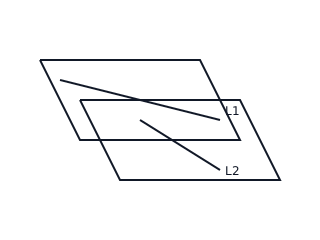
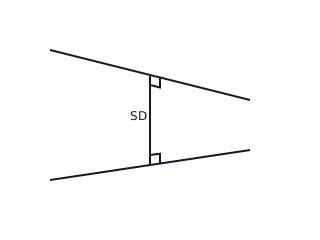
The shortest distance between two skew lines is the length of the line segment that is perpendicular to both lines simultaneously. This segment is called the line of shortest distance.
If two lines intersect, the shortest distance between them is zero. In this case, the scalar triple product equals zero.
For parallel lines, the shortest distance is the perpendicular distance from any point on one line to the other line. This is calculated using the cross product of the direction vector and the vector connecting points on both lines.
📐Formulae
Vector Form (Skew Lines):
Cartesian Form:
Distance between Parallel Lines:
Vector Cross Product:
💡Examples
Problem 1:
Find the shortest distance between the lines and .
Solution:
- Identify vectors: , , , .
- Calculate .
- Calculate .
- Find magnitude .
- Calculate dot product: .
- Apply formula: units.
Explanation:
We first extracted the position and direction vectors for both lines. We then calculated the cross product of the direction vectors to find the common perpendicular. Finally, we projected the vector connecting the two lines onto this common perpendicular to find the magnitude of the shortest distance.
Problem 2:
Find the shortest distance between the parallel lines and .
Solution:
- Identify: , , and common direction .
- Find .
- Calculate .
- Magnitude .
- Magnitude .
- Distance units.
Explanation:
Since the direction vectors are identical, the lines are parallel. We used the specific parallel distance formula, which involves the cross product of the common direction vector with the vector connecting points on each line, divided by the magnitude of the direction vector.
Problem 3:
Find the shortest distance between the lines given by the Cartesian equations: Line 1: Line 2:
Solution:
-
Identify coordinates and direction ratios: Line 1: and Line 2: and $(l_2, m_2, n_2) = (-3, 2, 4)
-
Calculate .
-
Evaluate the determinant in the numerator:
-
Calculate the denominator :
-
Shortest Distance units.
Explanation:
We use the determinant method for Cartesian equations of skew lines. The numerator represents the volume of the parallelepiped formed by the vector connecting the points and the direction vectors, while the denominator is the magnitude of the cross product of the direction vectors.
Problem 4:
Verify if the lines and intersect. If not, find the shortest distance.
Solution:
-
Extract vectors: , ,
-
Calculate .
-
Calculate :
-
Calculate . Since the product is not zero, the lines do not intersect.
-
Calculate magnitude .
-
Distance units.
Explanation:
If the scalar triple product of , , and is non-zero, the lines are skew. We then divide the absolute value of this product by the magnitude of the cross product of the direction vectors.