
Review the key concepts, formulae, and examples before starting your quiz.
🔑Concepts
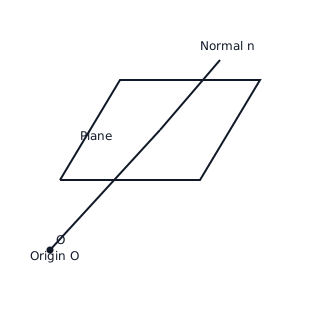
The Normal Form of a plane is defined by its distance from the origin and a unit normal vector perpendicular to the plane. The vector equation is . In Cartesian form, this is , where are the direction cosines of the normal.
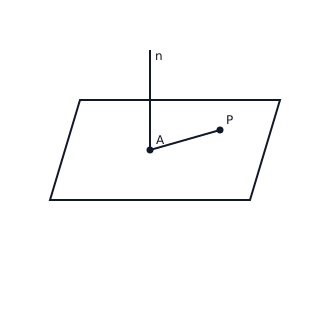
A plane is uniquely determined if it passes through a fixed point with position vector and is perpendicular to a given vector . Every point on the plane must satisfy the condition that the vector is perpendicular to , leading to .
The Intercept Form of the equation of a plane is , where are the lengths of the intercepts made by the plane on the and axes respectively.
The shortest distance from a point to a plane is the length of the perpendicular dropped from the point to the plane.
📐Formulae
Vector equation of a plane in normal form:
Cartesian equation of a plane in normal form: (where are direction cosines)
Vector equation of a plane passing through point and normal to :
Cartesian equation of a plane passing through with normal vector direction ratios :
General Cartesian equation of a plane:
Intercept form:
Equation of a plane passing through three non-collinear points , , and :
Perpendicular distance of a point from the plane :
💡Examples
Problem 1:
Find the vector and Cartesian equations of the plane which passes through the point and is perpendicular to the line with direction ratios .
Solution:
- Let the position vector of the given point be .
- The normal vector is given by the direction ratios of the line: .
- The vector equation is .
- Calculate .
- Vector Equation: .
- Cartesian Equation: Substitute to get .
Explanation:
This problem uses the point-normal form. We identify the given point as and the perpendicular direction as the normal vector . The dot product of the arbitrary position vector and the normal equals the dot product of the known point and the normal.
Problem 2:
Find the equation of the plane that makes intercepts and on the and axes respectively.
Solution:
- The intercepts are given as .
- Use the intercept form: .
- Substitute the values: .
- To clear the fractions, find the LCM of and , which is .
- Multiply the entire equation by : .
Explanation:
The intercept form is the most efficient way to find the equation when the points where the plane crosses the axes are known. We simply substitute the intercept values into the standard formula and simplify to general form.
Problem 3:
Find the equation of the plane passing through the points , , and .
Solution:
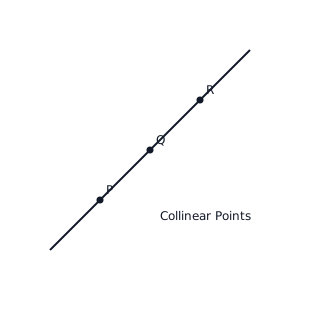
The general equation of a plane passing through is . Substituting : ...(i) Since and lie on the plane: Notice these equations are dependent (one is the negative of the other). This suggests the points are collinear. However, testing the ratio: . Since the points are collinear, infinitely many planes can pass through them. Usually, for a unique plane, we use the determinant: Since Row 2 and Row 3 are proportional, the determinant is for any satisfying a specific linear relation, or in this case, it confirms the points do not form a unique plane.
Explanation:
To find a unique plane through three points, they must be non-collinear. If the determinant results in , the points are collinear.
Problem 4:
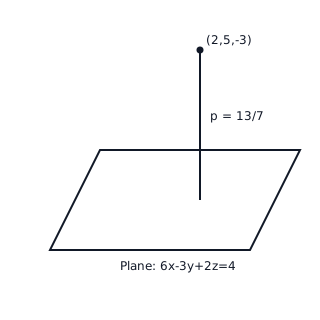
Find the distance of the point from the plane .
Solution:
The Cartesian equation of the plane is . Given point . . Distance units.
Explanation:
Convert the vector equation to Cartesian form, then apply the perpendicular distance formula.