krit.club logo

Three-Dimensional Geometry - Direction Cosines and Ratios of a Line

Grade 12ICSE

Review the key concepts, formulae, and examples before starting your quiz.

🔑Concepts

•

Direction angles are the angles α,β,γ\alpha, \beta, \gamma that a line LL makes with the positive directions of the X,Y,X, Y, and ZZ axes respectively. The cosines of these angles, l=cos⁡αl = \cos\alpha, m=cos⁡βm = \cos\beta, and n=cos⁡γn = \cos\gamma, are called the direction cosines (D.C.s) of the line.
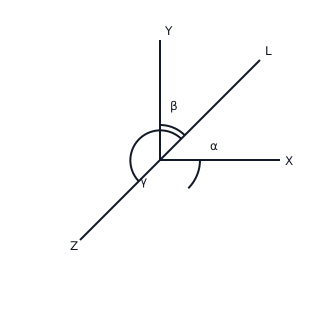
A 3D coordinate system showing a line L making angles alpha, beta, and gamma with the X, Y, and Z axes.
•

Direction ratios (D.R.s) are any three numbers a,b,ca, b, c that are proportional to the direction cosines l,m,nl, m, n. Unlike direction cosines which must satisfy l2+m2+n2=1l^2 + m^2 + n^2 = 1, direction ratios can be any real numbers that represent the vector component along the axes.
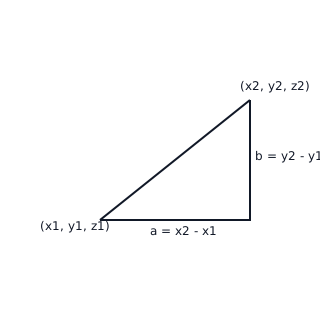
Geometric representation of direction ratios as the difference between coordinates of two points on a line.
•

The relationship between D.C.s and D.R.s is given by dividing each ratio by the magnitude a2+b2+c2\sqrt{a^2 + b^2 + c^2}. This 'normalizes' the direction ratios to unit length, resulting in the direction cosines.

Flowchart showing the conversion from Direction Ratios to Direction Cosines.
•

The angle θ\theta between two lines is determined by the dot product of their direction vectors. If two lines are perpendicular, the sum of the products of their corresponding direction ratios is zero (a1a2+b1b2+c1c2=0a_1a_2 + b_1b_2 + c_1c_2 = 0). If they are parallel, their direction ratios are proportional.
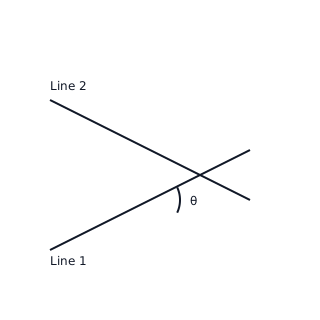
Two intersecting lines in space forming an angle theta.

📐Formulae

l=cos⁡α,m=cos⁡β,n=cos⁡γl = \cos\alpha, m = \cos\beta, n = \cos\gamma

l2+m2+n2=1l^2 + m^2 + n^2 = 1

l=±aa2+b2+c2,m=±ba2+b2+c2,n=±ca2+b2+c2l = \pm \frac{a}{\sqrt{a^2+b^2+c^2}}, m = \pm \frac{b}{\sqrt{a^2+b^2+c^2}}, n = \pm \frac{c}{\sqrt{a^2+b^2+c^2}}

Direction Ratios for points (x1,y1,z1) and (x2,y2,z2):a=(x2−x1),b=(y2−y1),c=(z2−z1)\text{Direction Ratios for points } (x_1, y_1, z_1) \text{ and } (x_2, y_2, z_2): a = (x_2-x_1), b = (y_2-y_1), c = (z_2-z_1)

cos⁡θ=∣a1a2+b1b2+c1c2∣a12+b12+c12a22+b22+c22\cos\theta = \frac{|a_1a_2 + b_1b_2 + c_1c_2|}{\sqrt{a_1^2+b_1^2+c_1^2}\sqrt{a_2^2+b_2^2+c_2^2}}

Condition for Parallelism: a1a2=b1b2=c1c2\text{Condition for Parallelism: } \frac{a_1}{a_2} = \frac{b_1}{b_2} = \frac{c_1}{c_2}

Condition for Perpendicularity: a1a2+b1b2+c1c2=0\text{Condition for Perpendicularity: } a_1a_2 + b_1b_2 + c_1c_2 = 0

💡Examples

Problem 1:

Find the direction cosines of a line that passes through the points A(2,3,5)A(2, 3, 5) and B(−1,2,4)B(-1, 2, 4).

Solution:

  1. Find the Direction Ratios (DRs) by subtracting coordinates: a=x2−x1=−1−2=−3a = x_2 - x_1 = -1 - 2 = -3 b=y2−y1=2−3=−1b = y_2 - y_1 = 2 - 3 = -1 c=z2−z1=4−5=−1c = z_2 - z_1 = 4 - 5 = -1 So, the DRs are (−3,−1,−1)(-3, -1, -1).

  2. Calculate the magnitude: a2+b2+c2=(−3)2+(−1)2+(−1)2=9+1+1=11\sqrt{a^2 + b^2 + c^2} = \sqrt{(-3)^2 + (-1)^2 + (-1)^2} = \sqrt{9 + 1 + 1} = \sqrt{11}.

  3. Calculate Direction Cosines (DCs): l=−311,m=−111,n=−111l = \frac{-3}{\sqrt{11}}, m = \frac{-1}{\sqrt{11}}, n = \frac{-1}{\sqrt{11}}.

Therefore, the DCs are (−311,−111,−111)(\frac{-3}{\sqrt{11}}, \frac{-1}{\sqrt{11}}, \frac{-1}{\sqrt{11}}).

Explanation:

To find the direction cosines, we first determine the direction ratios by finding the vector connecting the two points. We then normalize these ratios by dividing them by the total magnitude of the vector to ensure the sum of the squares of the cosines equals 1.

Problem 2:

Show that the line passing through the points (4,7,8)(4, 7, 8) and (2,3,4)(2, 3, 4) is parallel to the line passing through the points (−1,−2,1)(-1, -2, 1) and (1,2,5)(1, 2, 5).

Solution:

  1. Find DRs of the first line (L1L_1) passing through (4,7,8)(4, 7, 8) and (2,3,4)(2, 3, 4): a1=2−4=−2,b1=3−7=−4,c1=4−8=−4a_1 = 2 - 4 = -2, b_1 = 3 - 7 = -4, c_1 = 4 - 8 = -4. DRs of L1L_1 are (−2,−4,−4)(-2, -4, -4).

  2. Find DRs of the second line (L2L_2) passing through (−1,−2,1)(-1, -2, 1) and (1,2,5)(1, 2, 5): a2=1−(−1)=2,b2=2−(−2)=4,c2=5−1=4a_2 = 1 - (-1) = 2, b_2 = 2 - (-2) = 4, c_2 = 5 - 1 = 4. DRs of L2L_2 are (2,4,4)(2, 4, 4).

  3. Check for proportionality: a1a2=−22=−1\frac{a_1}{a_2} = \frac{-2}{2} = -1 b1b2=−44=−1\frac{b_1}{b_2} = \frac{-4}{4} = -1 c1c2=−44=−1\frac{c_1}{c_2} = \frac{-4}{4} = -1

Since a1a2=b1b2=c1c2\frac{a_1}{a_2} = \frac{b_1}{b_2} = \frac{c_1}{c_2}, the lines are parallel.

Explanation:

Two lines are parallel if their direction ratios are proportional. In this case, the direction ratios of the second line are simply the direction ratios of the first line multiplied by the scalar −1-1, confirming they point in the same (or exactly opposite) direction.

Problem 3:

Find the direction cosines of a line which makes equal angles with the coordinate axes.
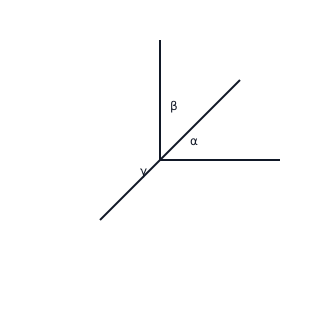
Line equidistant from all three coordinate axes showing angles alpha, beta, and gamma.

Solution:

Let the line make angles α\alpha, β\beta, and γ\gamma with the xx, yy, and zz axes respectively. Given: α=β=γ\alpha = \beta = \gamma. So, cos⁡α=cos⁡β=cos⁡γ\cos\alpha = \cos\beta = \cos\gamma, which means l=m=nl = m = n. We know that l2+m2+n2=1l^2 + m^2 + n^2 = 1. Substituting the values: l2+l2+l2=1⇒3l2=1⇒l=±13l^2 + l^2 + l^2 = 1 \Rightarrow 3l^2 = 1 \Rightarrow l = \pm \frac{1}{\sqrt{3}}. Thus, l=m=n=±13l = m = n = \pm \frac{1}{\sqrt{3}}. The direction cosines are (±13,±13,±13)(\pm \frac{1}{\sqrt{3}}, \pm \frac{1}{\sqrt{3}}, \pm \frac{1}{\sqrt{3}}).

Explanation:

Since the angles are equal, the cosines are equal. Using the identity l2+m2+n2=1l^2+m^2+n^2=1, we find the value for each component.

Problem 4:

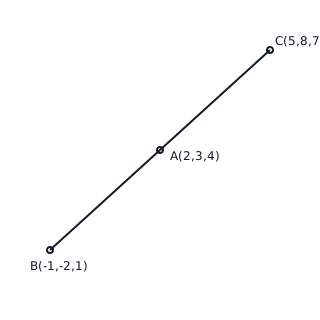
Show that the points A(2,3,4)A(2, 3, 4), B(−1,−2,1)B(-1, -2, 1) and C(5,8,7)C(5, 8, 7) are collinear.

Three points A, B, and C lying on the same straight line.

Solution:

The direction ratios of line segment ABAB are: a1=−1−2=−3a_1 = -1 - 2 = -3 b1=−2−3=−5b_1 = -2 - 3 = -5 c1=1−4=−3c_1 = 1 - 4 = -3

The direction ratios of line segment BCBC are: a2=5−(−1)=6a_2 = 5 - (-1) = 6 b2=8−(−2)=10b_2 = 8 - (-2) = 10 c2=7−1=6c_2 = 7 - 1 = 6

Comparing the ratios: a1a2=−36=−12\frac{a_1}{a_2} = \frac{-3}{6} = -\frac{1}{2} b1b2=−510=−12\frac{b_1}{b_2} = \frac{-5}{10} = -\frac{1}{2} c1c2=−36=−12\frac{c_1}{c_2} = \frac{-3}{6} = -\frac{1}{2}

Since the direction ratios of ABAB and BCBC are proportional, ABAB is parallel to BCBC. Since BB is a common point, A,BA, B, and CC are collinear.

Explanation:

Points are collinear if the vectors formed by consecutive points have proportional direction ratios (i.e., they are parallel and share a point).