krit.club logo

Three-Dimensional Geometry - Distance of a Point from a Plane

Grade 12ICSE

Review the key concepts, formulae, and examples before starting your quiz.

🔑Concepts

•

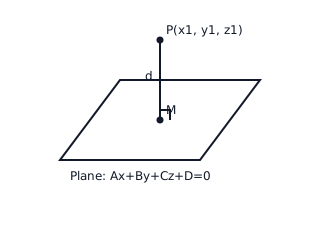
The distance from a point to a plane is the length of the perpendicular segment dropped from the point to the plane. In the Cartesian system, if a point P(x1,y1,z1)P(x_1, y_1, z_1) is given and the plane is Ax+By+Cz+D=0Ax + By + Cz + D = 0, the shortest distance is measured along the normal vector n⃗=Ai^+Bj^+Ck^\vec{n} = A\hat{i} + B\hat{j} + C\hat{k}.

Diagram showing a point P above a plane with a perpendicular line segment PM representing the distance d.
•

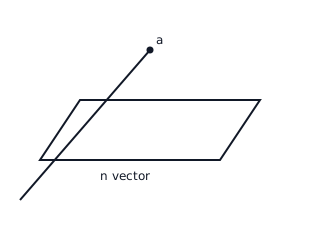
When using vector notation, the distance from a point with position vector a⃗\vec{a} to a plane defined by r⃗⋅n⃗=q\vec{r} \cdot \vec{n} = q is found by projecting the vector (a⃗−p⃗)(\vec{a} - \vec{p}) onto the normal unit vector, where p⃗\vec{p} is any point on the plane. This simplifies to the scalar projection formula d=∣a⃗⋅n⃗−q∣∣n⃗∣d = \frac{|\vec{a} \cdot \vec{n} - q|}{|\vec{n}|}.

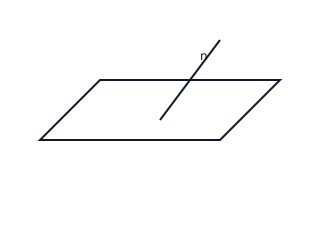
Normal vector n perpendicular to a plane surface.
•

Distance from the origin (0,0,0)(0,0,0) is a specific case of the Cartesian formula. It simplifies to the absolute value of the constant term DD divided by the magnitude of the normal vector: d=∣D∣A2+B2+C2d = \frac{|D|}{\sqrt{A^2 + B^2 + C^2}}. This represents the shortest path from the center of the coordinate system to the plane's surface.

•

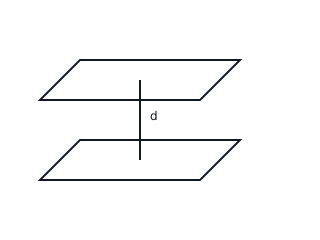
Parallel planes have identical normal vectors (coefficients A,B,CA, B, C) but different constant terms D1D_1 and D2D_2. The distance between them is constant everywhere and is given by the difference of their individual distances from the origin: d=∣D1−D2∣A2+B2+C2d = \frac{|D_1 - D_2|}{\sqrt{A^2 + B^2 + C^2}}.

Two parallel planes stacked vertically with a distance d between them.

📐Formulae

Cartesian Distance from P(x1,y1,z1)P(x_1, y_1, z_1) to Ax+By+Cz+D=0Ax + By + Cz + D = 0: d=∣Ax1+By1+Cz1+D∣A2+B2+C2d = \frac{|Ax_1 + By_1 + Cz_1 + D|}{\sqrt{A^2 + B^2 + C^2}}

Vector Distance from point a⃗\vec{a} to plane r⃗⋅n⃗=q\vec{r} \cdot \vec{n} = q: d=∣a⃗⋅n⃗−q∣∣n⃗∣d = \frac{|\vec{a} \cdot \vec{n} - q|}{|\vec{n}|}

Distance from Origin (0,0,0)(0, 0, 0) to Ax+By+Cz+D=0Ax + By + Cz + D = 0: d=∣D∣A2+B2+C2d = \frac{|D|}{\sqrt{A^2 + B^2 + C^2}}

Distance between parallel planes Ax+By+Cz+D1=0Ax + By + Cz + D_1 = 0 and Ax+By+Cz+D2=0Ax + By + Cz + D_2 = 0: d=∣D1−D2∣A2+B2+C2d = \frac{|D_1 - D_2|}{\sqrt{A^2 + B^2 + C^2}}

Vector form with unit normal: If n^\hat{n} is a unit vector, the distance from a⃗\vec{a} to r⃗⋅n^=p\vec{r} \cdot \hat{n} = p is d=∣a⃗⋅n^−p∣d = |\vec{a} \cdot \hat{n} - p|

💡Examples

Problem 1:

Find the distance of the point (2,5,−3)(2, 5, -3) from the plane 6x−3y+2z−4=06x - 3y + 2z - 4 = 0.

Solution:

  1. Identify the coordinates of the point: x1=2,y1=5,z1=−3x_1 = 2, y_1 = 5, z_1 = -3.
  2. Identify coefficients from the plane equation: A=6,B=−3,C=2,D=−4A = 6, B = -3, C = 2, D = -4.
  3. Apply the distance formula: d=∣6(2)+(−3)(5)+2(−3)−4∣62+(−3)2+22d = \frac{|6(2) + (-3)(5) + 2(-3) - 4|}{\sqrt{6^2 + (-3)^2 + 2^2}}
  4. Calculate the numerator: ∣12−15−6−4∣=∣−13∣=13|12 - 15 - 6 - 4| = |-13| = 13.
  5. Calculate the denominator: 36+9+4=49=7\sqrt{36 + 9 + 4} = \sqrt{49} = 7.
  6. Therefore, d=137d = \frac{13}{7} units.

Explanation:

This solution uses the Cartesian distance formula. We substitute the point's coordinates into the plane's linear expression, take the absolute value to ensure a positive distance, and divide by the magnitude of the normal vector.

Problem 2:

Find the distance between the parallel planes 2x−y+2z+3=02x - y + 2z + 3 = 0 and 4x−2y+4z+15=04x - 2y + 4z + 15 = 0.

Solution:

  1. Express both equations with the same coefficients for x,y,zx, y, z. Divide the second equation by 22: 2x−y+2z+152=02x - y + 2z + \frac{15}{2} = 0.
  2. Now we have A=2,B=−1,C=2A=2, B=-1, C=2.
  3. Identify the constants: D1=3D_1 = 3 and D2=152=7.5D_2 = \frac{15}{2} = 7.5.
  4. Use the parallel plane distance formula: d=∣D1−D2∣A2+B2+C2d = \frac{|D_1 - D_2|}{\sqrt{A^2 + B^2 + C^2}} d=∣3−7.5∣22+(−1)2+22d = \frac{|3 - 7.5|}{\sqrt{2^2 + (-1)^2 + 2^2}} d=∣−4.5∣4+1+4=4.53=1.5d = \frac{|-4.5|}{\sqrt{4 + 1 + 4}} = \frac{4.5}{3} = 1.5 units.

Explanation:

To find the distance between parallel planes, their x,y,zx, y, z coefficients must be identical first. Once normalized, the distance is the absolute difference between their constant terms divided by the length of the common normal vector.

Problem 3:

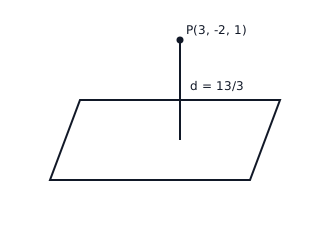
Find the length of the perpendicular from the point P(3,−2,1)P(3, -2, 1) to the plane 2x−y+2z+3=02x - y + 2z + 3 = 0.

Perpendicular distance from point (3, -2, 1) to the plane.

Solution:

  1. Identify the coordinates of point P(x1,y1,z1)=(3,−2,1)P(x_1, y_1, z_1) = (3, -2, 1).
  2. Identify the coefficients of the plane equation Ax+By+Cz+D=0Ax + By + Cz + D = 0: A=2,B=−1,C=2,D=3A = 2, B = -1, C = 2, D = 3.
  3. Substitute the values into the distance formula: d=∣(2)(3)+(−1)(−2)+(2)(1)+3∣22+(−1)2+22d = \frac{|(2)(3) + (-1)(-2) + (2)(1) + 3|}{\sqrt{2^2 + (-1)^2 + 2^2}}
  4. Calculate the numerator: ∣6+2+2+3∣=∣13∣=13|6 + 2 + 2 + 3| = |13| = 13.
  5. Calculate the denominator: 4+1+4=9=3\sqrt{4 + 1 + 4} = \sqrt{9} = 3.
  6. Result: d=133d = \frac{13}{3} units.

Explanation:

The formula d=∣Ax1+By1+Cz1+D∣A2+B2+C2d = \frac{|Ax_1 + By_1 + Cz_1 + D|}{\sqrt{A^2 + B^2 + C^2}} is used to calculate the shortest distance from a specific point to a flat surface in 3D space.

Problem 4:

Find the distance of the point with position vector a⃗=i^+2j^−3k^\vec{a} = \hat{i} + 2\hat{j} - 3\hat{k} from the plane r⃗⋅(3i^−4j^+12k^)=5\vec{r} \cdot (3\hat{i} - 4\hat{j} + 12\hat{k}) = 5.

Vector representation of a point a and normal vector n to a plane.

Solution:

  1. Here, a⃗=i^+2j^−3k^\vec{a} = \hat{i} + 2\hat{j} - 3\hat{k}, n⃗=3i^−4j^+12k^\vec{n} = 3\hat{i} - 4\hat{j} + 12\hat{k}, and q=5q = 5.
  2. Calculate a⃗⋅n⃗\vec{a} \cdot \vec{n}: a⃗⋅n⃗=(1)(3)+(2)(−4)+(−3)(12)=3−8−36=−41\vec{a} \cdot \vec{n} = (1)(3) + (2)(-4) + (-3)(12) = 3 - 8 - 36 = -41
  3. Calculate the magnitude of n⃗\vec{n}: ∣n⃗∣=32+(−4)2+122=9+16+144=169=13|\vec{n}| = \sqrt{3^2 + (-4)^2 + 12^2} = \sqrt{9 + 16 + 144} = \sqrt{169} = 13
  4. Use the vector distance formula: d=∣a⃗⋅n⃗−q∣∣n⃗∣=∣−41−5∣13=∣−46∣13=4613d = \frac{|\vec{a} \cdot \vec{n} - q|}{|\vec{n}|} = \frac{|-41 - 5|}{13} = \frac{|-46|}{13} = \frac{46}{13}
  5. Result: d=4613d = \frac{46}{13} units.

Explanation:

This problem uses the vector form of the distance equation. It involves taking the dot product of the point's position vector and the plane's normal vector, subtracting the plane's constant, and normalizing by the magnitude of the normal vector.