
Review the key concepts, formulae, and examples before starting your quiz.
🔑Concepts
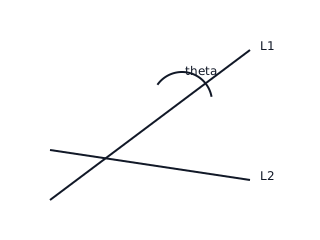
The angle between two lines is determined by the dot product of their direction vectors and . If the lines are perpendicular, their dot product is zero (). If they are parallel, their direction ratios are proportional.
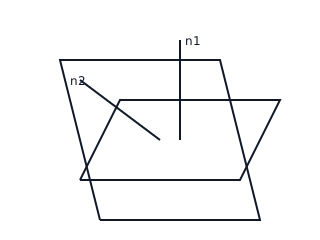
The angle between two planes is defined as the angle between their normal vectors and . If the planes are and , the cosine of the angle is calculated using the coefficients of the variables.
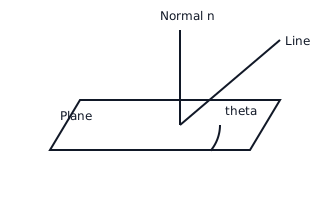
The angle between a line and a plane is the complement of the angle between the line and the normal to the plane. Hence, we use the formula: , where is the direction of the line and is the normal to the plane.
Condition for perpendicularity: For two lines, . For a line and a plane, the direction ratios of the line must be proportional to the direction ratios of the normal ().
📐Formulae
Angle between two lines with direction ratios and :
Angle between two lines using vector form and :
Angle between two planes and :
Angle between a line with direction ratios and a plane :
Angle between a line and a plane :
💡Examples
Problem 1:
Find the angle between the two lines whose direction ratios are and .
Solution:
- Let the direction ratios be and .
- Use the formula .
- Calculate the numerator: .
- Calculate the denominators: and .
- .
- Therefore, or .
Explanation:
To find the angle between two lines, we apply the cosine formula using their direction ratios. The calculation involves finding the dot product of the direction vectors and dividing by the product of their magnitudes.
Problem 2:
Find the angle between the line and the plane .
Solution:
- Identify the direction ratios of the line: .
- Identify the direction ratios of the normal to the plane: .
- Use the formula for the angle between a line and a plane: .
- Calculate the numerator: .
- Calculate the denominators: and .
- .
- .
Explanation:
The angle between a line and a plane is calculated using the sine of the angle, relating the line's direction vector and the plane's normal vector. Note that we take the absolute value to ensure we find the acute angle.
Problem 3:
Find the angle between the planes and .
Solution:
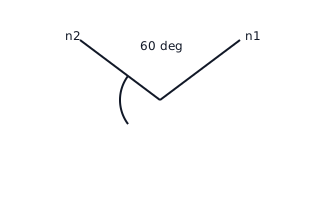
- Identify the normal vectors of the planes:
- Use the formula
- Calculate dot product:
- Calculate magnitudes:
- Substitute values:
- Therefore, .
Explanation:
The angle between two planes is the angle between their normal vectors. We extract the normal vectors from the coefficients of and apply the cosine dot product formula.
Problem 4:
Calculate the angle between the line and the plane .
Solution:
- Identify the direction vector of the line:
- Identify the normal vector of the plane:
- Use the formula
- Calculate dot product:
- Calculate magnitudes:
- Substitute:
- Thus, .
Explanation:
For the angle between a line and a plane, we use the sine of the angle because the geometric angle is the complement of the angle between the line and the plane's normal.