
Review the key concepts, formulae, and examples before starting your quiz.
🔑Concepts
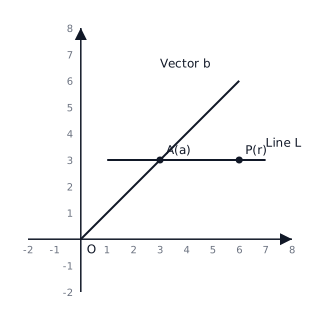
The equation of a line in 3D space is uniquely determined if it passes through a given point with position vector and is parallel to a given direction vector . This is represented in vector form as .
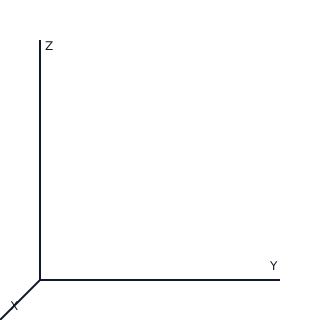
In Cartesian form, the equation of a line passing through with direction ratios is . These ratios are the components of the direction vector .
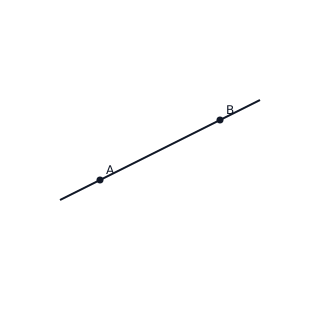
A line can also be defined by two distinct points and . The direction ratios are found by the difference of their coordinates: .
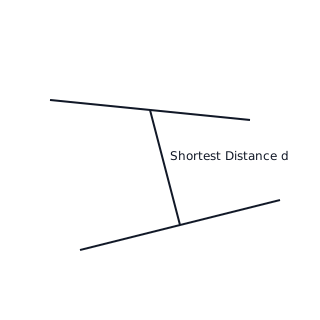
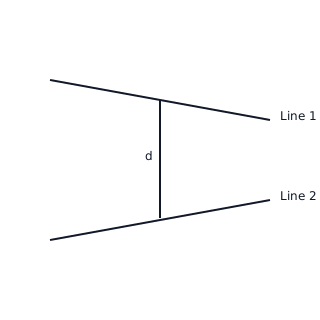
The shortest distance between two skew lines is the length of the common perpendicular to both lines. If the distance is zero, the lines intersect.
📐Formulae
Vector equation (Point and Direction):
Cartesian equation (Point and Direction):
Vector equation (Two points):
Cartesian equation (Two points):
Angle between lines:
Shortest distance (Skew lines):
Shortest distance (Parallel lines):
💡Examples
Problem 1:
Find the vector and Cartesian equations of the line passing through the point and which is parallel to the vector .
Solution:
- Identify the given point vector: .
- Identify the direction vector: .
- Plug into the vector equation formula : .
- For Cartesian equation, use and direction ratios : .
Explanation:
This problem demonstrates the direct conversion from physical coordinates and a direction vector into both standard forms of a 3D line.
Problem 2:
Find the angle between the pair of lines given by: and .
Solution:
- Identify direction ratios of first line: .
- Identify direction ratios of second line: .
- Use the cosine formula:
- Calculate numerator: .
- Calculate denominator: .
- .
- .
Explanation:
The angle between lines depends solely on their direction ratios. We extract the denominators from the Cartesian form and apply the dot product formula.
Problem 3:
Find the Cartesian equation of the line passing through the points and .
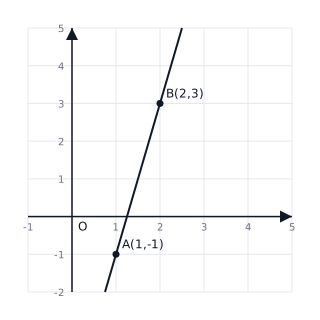
Solution:
- Identify coordinates: and .
- Calculate direction ratios:
- Apply the formula:
- Result:
Explanation:
To find the equation through two points, we first find the direction vector by subtracting the coordinates of the first point from the second, then substitute into the point-direction Cartesian form.
Problem 4:
Find the shortest distance between the lines and .
Solution:
- Identify vectors: , , , .
- Compute .
- Compute .
- Magnitude .
- Dot product .
- Distance units.
Explanation:
Skew lines are lines that are not parallel and do not intersect. The shortest distance is the projection of the vector joining two points (one on each line) onto the vector perpendicular to both lines.