
🔑Concepts
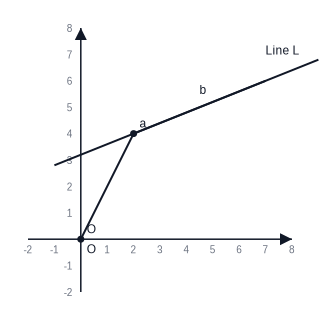
A line in 3D space is uniquely defined by a position vector (a fixed point on the line) and a direction vector (indicating the line's orientation). The general equation is , where is a scalar parameter.
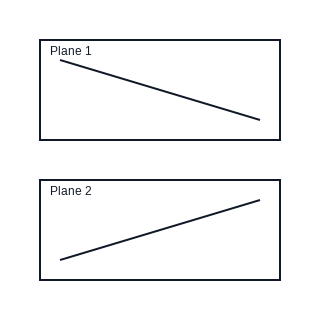
Two lines in 3D space can be parallel, intersecting, or skew. Skew lines are non-parallel lines that do not intersect because they lie in different planes.
The angle between two lines is determined solely by the dot product of their direction vectors and . If , the lines are perpendicular.
The shortest distance from a point to a line can be found by creating a vector from the point to a general point on the line and ensuring it is perpendicular to the direction vector.
📐Formulae
\begin{pmatrix} x_0 \ y_0 \ z_0 \end{pmatrix}
💡Examples
Problem 1:
Find the vector equation of the line passing through the points and .
Solution:
First, find the direction vector : = Using point as the position vector : +
Explanation:
To find the vector equation, we need a point on the line (position vector) and the vector connecting two points (direction vector). Subtract coordinates of the start point from the end point to get the direction.
Problem 2:
Determine if the lines and + intersect.
Solution:
Equate the components of and :
- Substitute and into the third equation: Since the values are consistent, they intersect. The point of intersection is found by substituting into : =
Explanation:
To check for intersection, create a system of three linear equations based on the components. If a consistent pair of parameters satisfies all three equations, the lines intersect.
Problem 3:
Find the acute angle between the lines with direction vectors and .
Solution:
Calculate the dot product: . Calculate magnitudes: Apply the formula:
Explanation:
The angle between two lines is defined as the angle between their direction vectors. We use the cosine rule for dot products to solve for .
Problem 4:
Calculate the coordinates of the point of intersection between the lines and .
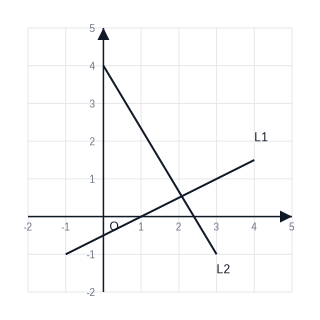
Solution:
Set the components equal:
Solving (1) and (2): Multiply (1) by 2: Subtract (2): Substitute into (1):
Check in (3): . Since the values do not satisfy the third equation, the lines do not intersect (they are skew).
Explanation:
To find an intersection, we equate the and components to create a system of equations. We solve for the parameters using two equations and verify with the third. If it doesn't match, they are skew.
Problem 5:
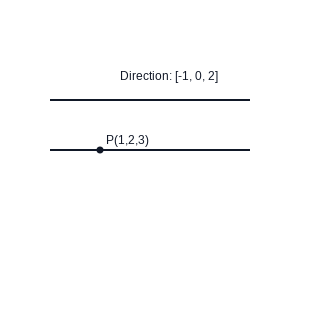
Find the vector equation of the line that passes through the point and is parallel to the line .
Solution:
Parallel lines share the same direction vector. The direction vector of the given line is . The position vector of the point is . The equation of the new line is:
Explanation:
Since the lines are parallel, we use the direction vector from the known line and the coordinates of the given point as the starting position vector.
Finished reading?
Practice Vector equations (HL) with a worksheet. Answers included.