
Review the key concepts, formulae, and examples before starting your quiz.
🔑Concepts
The distance between two points and in a 2D plane is the length of the straight line segment connecting them, derived from the Pythagorean theorem.
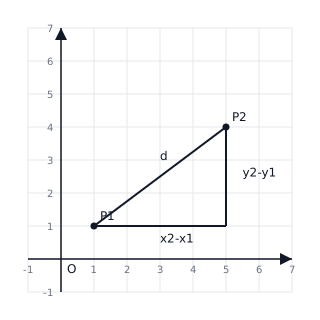
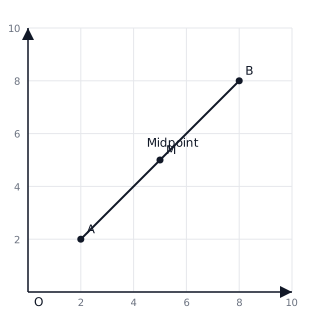
The midpoint of a line segment is the point that divides the segment into two equal parts. Its coordinates are the averages of the and coordinates of the endpoints.
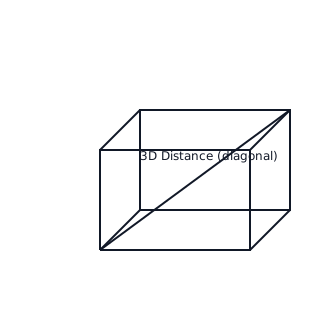
In 3D space, the distance formula extends to include the -coordinate, calculating the length of a vector in three dimensions using .
The midpoint in 3D is found by separately averaging the , , and coordinates of the two endpoints: .
To find an unknown endpoint when given one endpoint and the midpoint, you can use the midpoint formula algebraically or by considering the 'step' (displacement) from the endpoint to the midpoint and repeating it.
📐Formulae
💡Examples
Problem 1:
Find the distance between the points and .
Solution:
Explanation:
Substitute the coordinates into the 2D distance formula. Note that becomes .
Problem 2:
A line segment has endpoints and . Determine the coordinates of the midpoint.
Solution:
Explanation:
To find the midpoint in 3D, calculate the average of the , , and coordinates separately.
Problem 3:
The midpoint of segment is . If point is , find the coordinates of point .
Solution:
Explanation:
Set up the midpoint formula equations using the known midpoint and one endpoint, then solve for the unknown coordinates and .
Problem 4:
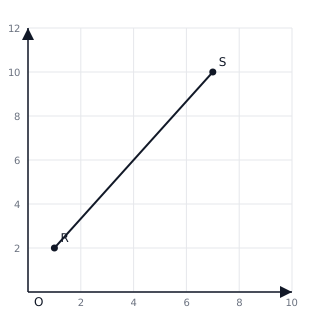
A surveyor is measuring a rectangular plot. Point is located at and point is at . Calculate the exact length of the diagonal .
Solution:
- Identify coordinates: and .
- Use the distance formula:
- Simplify:
- units.
Explanation:
To find the distance, we calculate the difference between the and coordinates, square them, sum them, and take the square root. This is the magnitude of the vector from to .
Problem 5:
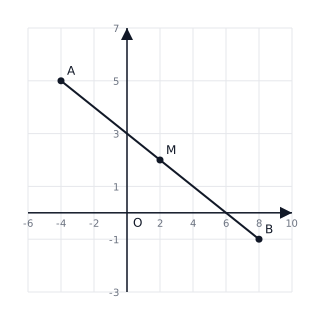
A transmission tower is anchored at point and its base is at point . A technician needs to install a sensor at the midpoint of the support cable . Find the coordinates of .
Solution:
- Identify coordinates: and .
- Apply the midpoint formula:
- Calculate -coordinate:
- Calculate -coordinate:
- .
Explanation:
The midpoint is found by averaging the horizontal and vertical positions of the two endpoints. The resulting coordinate lies exactly halfway between the anchor and the base.