krit.club logo

Geometry and Trigonometry - Sine Rule

Grade 12IB_AI

Review the key concepts, formulae, and examples before starting your quiz.

πŸ”‘Concepts

β€’

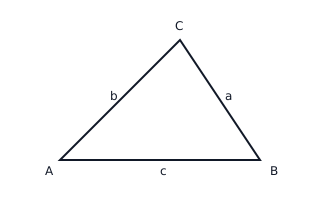
The Sine Rule relates the side lengths of any triangle (not just right-angled ones) to the sines of their opposite angles. The notation uses lowercase letters for sides (a,b,ca, b, c) and corresponding uppercase letters for the opposite angles (A,B,CA, B, C).

A general triangle ABC with side a opposite angle A, side b opposite angle B, and side c opposite angle C.
β€’

To find a missing side length, use the form where sides are in the numerator: asin⁑A=bsin⁑B=csin⁑C\frac{a}{\sin A} = \frac{b}{\sin B} = \frac{c}{\sin C}. This is best used when two angles and one opposite side are known (AAS or ASA).

β€’

To find a missing angle, use the reciprocal form where sines are in the numerator: sin⁑Aa=sin⁑Bb=sin⁑Cc\frac{\sin A}{a} = \frac{\sin B}{b} = \frac{\sin C}{c}. This requires two sides and one non-included angle (SSA).

β€’

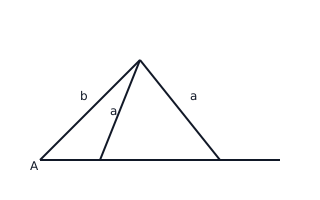
The Sine Rule can lead to the 'Ambiguous Case' when given two sides and a non-included acute angle (SSASSA). If the side opposite the given angle is shorter than the other given side, there may be two possible triangles (one acute, one obtuse) because sin⁑θ=sin⁑(180βˆ˜βˆ’ΞΈ)\sin \theta = \sin(180^{\circ} - \theta).

Diagram showing the ambiguous case where side 'a' can swing to two different positions on the base line, creating two possible triangles.

πŸ“Formulae

asin⁑A=bsin⁑B=csin⁑C\frac{a}{\sin A} = \frac{b}{\sin B} = \frac{c}{\sin C}

sin⁑Aa=sin⁑Bb=sin⁑Cc\frac{\sin A}{a} = \frac{\sin B}{b} = \frac{\sin C}{c}

πŸ’‘Examples

Problem 1:

In triangle ABCABC, angle A=40∘A = 40^{\circ}, angle B=65∘B = 65^{\circ}, and side a=12a = 12 cm. Calculate the length of side bb.

Solution:

bsin⁑65∘=12sin⁑40∘\frac{b}{\sin 65^{\circ}} = \frac{12}{\sin 40^{\circ}} b=12Γ—sin⁑65∘sin⁑40∘b = \frac{12 \times \sin 65^{\circ}}{\sin 40^{\circ}} bβ‰ˆ12Γ—0.90630.6428b \approx \frac{12 \times 0.9063}{0.6428} bβ‰ˆ16.9Β cmΒ (toΒ 3Β sig.Β fig.)b \approx 16.9 \text{ cm (to 3 sig. fig.)}

Explanation:

To find a missing side, we use the Sine Rule form with side lengths in the numerator. We substitute the known values for aa, AA, and BB, then rearrange the equation to solve for bb.

Problem 2:

In triangle PQRPQR, side p=8p = 8 cm, side q=10q = 10 cm, and angle P=35∘P = 35^{\circ}. Find the size of angle QQ (assume QQ is acute).

Solution:

sin⁑Q10=sin⁑35∘8\frac{\sin Q}{10} = \frac{\sin 35^{\circ}}{8} sin⁑Q=10Γ—sin⁑35∘8\sin Q = \frac{10 \times \sin 35^{\circ}}{8} sin⁑Qβ‰ˆ10Γ—0.57368\sin Q \approx \frac{10 \times 0.5736}{8} sin⁑Qβ‰ˆ0.7170\sin Q \approx 0.7170 Q=sinβ‘βˆ’1(0.7170)β‰ˆ45.8∘Q = \sin^{-1}(0.7170) \approx 45.8^{\circ}

Explanation:

To find a missing angle, we use the Sine Rule form with sines in the numerator. After substituting the values and calculating sin⁑Q\sin Q, we use the inverse sine function (sinβ‘βˆ’1\sin^{-1}) to find the angle.

Problem 3:

A surveyor at point AA measures the angle of elevation to the top of a tower TT as 25∘25^{\circ}. After walking 5050 m closer to the tower to point BB, the angle of elevation is 40∘40^{\circ}. Find the distance from BB to the top of the tower TT.

Solution:

In β–³ABT\triangle ABT: ∠TAB=25∘\angle TAB = 25^{\circ} ∠TBA=180βˆ˜βˆ’40∘=140∘\angle TBA = 180^{\circ} - 40^{\circ} = 140^{\circ} ∠ATB=180βˆ˜βˆ’(25∘+140∘)=15∘\angle ATB = 180^{\circ} - (25^{\circ} + 140^{\circ}) = 15^{\circ} Using Sine Rule in β–³ABT\triangle ABT to find BTBT (let BT=xBT = x): xsin⁑25∘=50sin⁑15∘\frac{x}{\sin 25^{\circ}} = \frac{50}{\sin 15^{\circ}} x=50Γ—sin⁑25∘sin⁑15∘x = \frac{50 \times \sin 25^{\circ}}{\sin 15^{\circ}} xβ‰ˆ50Γ—0.42260.2588β‰ˆ81.6Β mx \approx \frac{50 \times 0.4226}{0.2588} \approx 81.6 \text{ m}

Explanation:

First, we identify the angles inside the triangle formed by the two observation points and the top of the tower. We use the properties of angles on a straight line and the sum of angles in a triangle. Then, we apply the Sine Rule to find the required distance.

Problem 4:

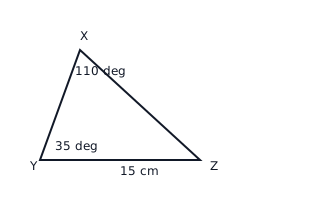
In triangle XYZXYZ, side x=15x = 15 cm, angle X=110∘X = 110^{\circ}, and angle Y=35∘Y = 35^{\circ}. Calculate the length of side zz.

Triangle XYZ with angle X=110, angle Y=35, and side x=15.

Solution:

  1. Find the third angle ZZ: Z=180βˆ˜βˆ’(110∘+35∘)=35∘Z = 180^{\circ} - (110^{\circ} + 35^{\circ}) = 35^{\circ}
  2. Use the Sine Rule to find side zz: zsin⁑Z=xsin⁑X\frac{z}{\sin Z} = \frac{x}{\sin X} zsin⁑35∘=15sin⁑110∘\frac{z}{\sin 35^{\circ}} = \frac{15}{\sin 110^{\circ}} z=15Γ—sin⁑35∘sin⁑110∘z = \frac{15 \times \sin 35^{\circ}}{\sin 110^{\circ}} zβ‰ˆ9.16Β cmz \approx 9.16 \text{ cm} (Note: Since angle Y=Y = angle ZZ, this is an isosceles triangle, so y=z=9.16y = z = 9.16 cm).

Explanation:

To find a side, we first ensure we have the angle opposite that side. Using the sum of angles in a triangle, we calculate the missing angle and then apply the Sine Rule ratio.

Problem 5:

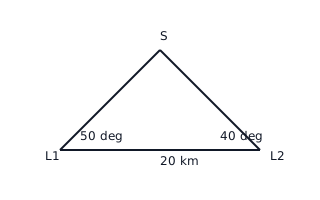
A ship is sailing between two lighthouses, L1L_1 and L2L_2, which are 2020 km apart. The bearing of the ship SS from L1L_1 is 040∘040^{\circ} and the bearing of the ship SS from L2L_2 is 310∘310^{\circ}. L2L_2 is due East of L1L_1. Calculate the distance from the ship to L2L_2.

Triangle representing the ship S and two lighthouses L1 and L2, showing the internal angles calculated from bearings.

Solution:

  1. Determine the internal angles of triangle L1L2SL_1 L_2 S: Angle at L1=90βˆ˜βˆ’40∘=50∘L_1 = 90^{\circ} - 40^{\circ} = 50^{\circ} Angle at L2=310βˆ˜βˆ’270∘=40∘L_2 = 310^{\circ} - 270^{\circ} = 40^{\circ}
  2. Calculate the angle at the ship SS: S=180βˆ˜βˆ’(50∘+40∘)=90∘S = 180^{\circ} - (50^{\circ} + 40^{\circ}) = 90^{\circ}
  3. Use the Sine Rule to find distance L2SL_2 S (side l1l_1): l1sin⁑50∘=20sin⁑90∘\frac{l_1}{\sin 50^{\circ}} = \frac{20}{\sin 90^{\circ}} l1=20Γ—sin⁑50∘l_1 = 20 \times \sin 50^{\circ} l1β‰ˆ15.3Β kml_1 \approx 15.3 \text{ km}

Explanation:

Convert bearings into internal triangle angles by referencing the horizontal (East-West) line. Once two angles and the side between them are known, the Sine Rule can solve for the remaining distances.