krit.club logo

Geometry and Trigonometry - Angles

Grade 12IB_AI

Review the key concepts, formulae, and examples before starting your quiz.

🔑Concepts

•

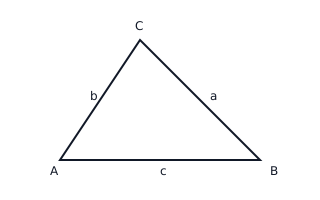
The Sine Rule: Used to find missing sides or angles in non-right-angled triangles when we know either two angles and one side (AAS/ASA) or two sides and a non-included angle (SSA). The formula is asin⁡A=bsin⁡B=csin⁡C\frac{a}{\sin A} = \frac{b}{\sin B} = \frac{c}{\sin C}.

Standard triangle labeling with sides opposite their corresponding angles.
•

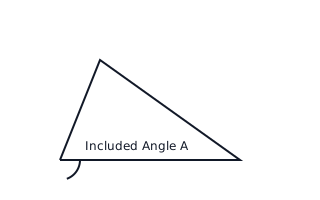
The Cosine Rule: Used to find a third side when two sides and the included angle (SAS) are known, or to find an angle when all three sides (SSS) are known. Formula: a2=b2+c2−2bccos⁡Aa^2 = b^2 + c^2 - 2bc \cos A.

Diagram showing two sides and the included angle used for the Cosine Rule.
•

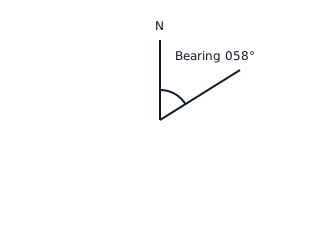
Bearings: These are angles measured clockwise from North (000∘000^\circ). They are always written with three digits (e.g., 045∘045^\circ for North-East).

A bearing diagram showing a measurement clockwise from North.
•

Angles of Elevation and Depression: These are measured from a horizontal line of sight looking up or down at an object.
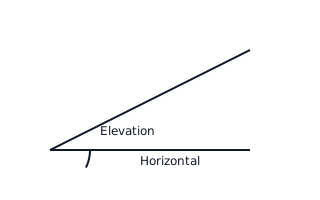
Angle of elevation measured between the horizontal and the line of sight.

📐Formulae

sin⁡θ=OH,cos⁡θ=AH,tan⁡θ=OA\sin \theta = \frac{O}{H}, \quad \cos \theta = \frac{A}{H}, \quad \tan \theta = \frac{O}{A}

asin⁡A=bsin⁡B=csin⁡C\frac{a}{\sin A} = \frac{b}{\sin B} = \frac{c}{\sin C}

a2=b2+c2−2bccos⁡Aa^2 = b^2 + c^2 - 2bc \cos A

cos⁡A=b2+c2−a22bc\cos A = \frac{b^2 + c^2 - a^2}{2bc}

Area of a triangle=12absin⁡C\text{Area of a triangle} = \frac{1}{2}ab \sin C

Arc length=θ360×2πr\text{Arc length} = \frac{\theta}{360} \times 2\pi r

Sector area=θ360×πr2\text{Sector area} = \frac{\theta}{360} \times \pi r^2

💡Examples

Problem 1:

In triangle ABCABC, side b=12b = 12 cm, side c=15c = 15 cm, and angle A=40∘A = 40^\circ. Calculate the length of side aa.

Solution:

Using the Cosine Rule: a2=122+152−2(12)(15)cos⁡(40∘)a^2 = 12^2 + 15^2 - 2(12)(15) \cos(40^\circ) a2=144+225−360(0.7660)a^2 = 144 + 225 - 360(0.7660) a2=369−275.77a^2 = 369 - 275.77 a2=93.23a^2 = 93.23 a=93.23≈9.66 cma = \sqrt{93.23} \approx 9.66 \text{ cm}

Explanation:

Since we have two sides and the included angle (SAS), the Cosine Rule is the appropriate formula to find the missing side opposite the given angle.

Problem 2:

A surveyor at point PP observes the top of a building QQ with an angle of elevation of 25∘25^\circ. If the surveyor is 5050 m away from the base of the building, find the height of the building.

Solution:

tan⁡(25∘)=height50\tan(25^\circ) = \frac{\text{height}}{50} height=50×tan⁡(25∘)\text{height} = 50 \times \tan(25^\circ) height=50×0.4663≈23.3 m\text{height} = 50 \times 0.4663 \approx 23.3 \text{ m}

Explanation:

Using the tangent ratio in a right-angled triangle where the horizontal distance is the adjacent side and the height is the opposite side.

Problem 3:

Calculate the area of a sector with a radius of 88 cm and a central angle of 120∘120^\circ.

Solution:

Area=120360×π×82\text{Area} = \frac{120}{360} \times \pi \times 8^2 Area=13×64π\text{Area} = \frac{1}{3} \times 64\pi Area≈67.0 cm2\text{Area} \approx 67.0 \text{ cm}^2

Explanation:

The sector area is a fraction of the total circle area, determined by the ratio of the central angle to 360∘360^\circ.

Problem 4:

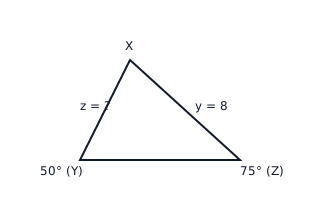
In triangle XYZXYZ, angle Y=50∘Y = 50^\circ, angle Z=75∘Z = 75^\circ, and side y=8y = 8 cm. Find the length of side zz.

Triangle XYZ with given angles and sides for Sine Rule calculation.

Solution:

  1. Identify that we have two angles and one side (AAS), so use the Sine Rule: ysin⁡Y=zsin⁡Z\frac{y}{\sin Y} = \frac{z}{\sin Z}
  2. Substitute the values: 8sin⁡50∘=zsin⁡75∘\frac{8}{\sin 50^\circ} = \frac{z}{\sin 75^\circ}
  3. Rearrange to solve for zz: z=8×sin⁡75∘sin⁡50∘z = \frac{8 \times \sin 75^\circ}{\sin 50^\circ}
  4. Calculate: z≈8×0.96590.7660≈10.09 cmz \approx \frac{8 \times 0.9659}{0.7660} \approx 10.09 \text{ cm}

Explanation:

Because we are given two angles and a side opposite one of them, the Sine Rule is the most direct method to find the other side.

Problem 5:

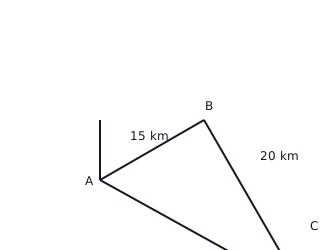
A ship sails 1515 km on a bearing of 060∘060^\circ from port AA to point BB. It then sails 2020 km on a bearing of 150∘150^\circ to point CC. Calculate the distance ACAC directly.

Bearing diagram showing path from A to B to C forming a right-angled triangle.

Solution:

  1. Determine the internal angle at BB. The angle between the path ABAB and the North line is 60∘60^\circ. Using alternate angles, the angle from BB to South is 60∘60^\circ. The bearing 150∘150^\circ from BB to CC leaves an angle of 30∘30^\circ from the South line (180−150=30180 - 150 = 30). Total angle ABC=60+30=90∘ABC = 60 + 30 = 90^\circ.
  2. Since it is a right-angled triangle, use Pythagoras: AC2=AB2+BC2AC^2 = AB^2 + BC^2 AC2=152+202AC^2 = 15^2 + 20^2 AC2=225+400=625AC^2 = 225 + 400 = 625 AC=625=25 kmAC = \sqrt{625} = 25 \text{ km}

Explanation:

By breaking down the bearings, we found that the internal angle at point B is 90∘90^\circ, allowing us to use the Pythagorean theorem for the distance calculation.