
Review the key concepts, formulae, and examples before starting your quiz.
🔑Concepts
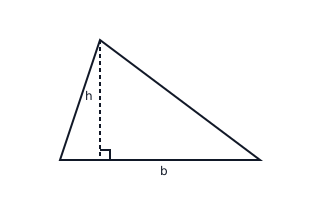
The fundamental formula for the area of a triangle is . The height () must be perpendicular to the base ().
When two sides and and the included angle are known, the area is given by . This is particularly useful in non-right-angled triangles where the height is not immediately obvious.
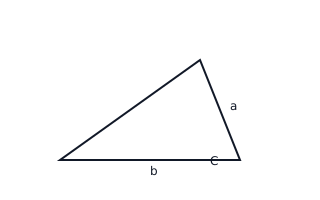
Heron's Formula allows the calculation of the area when only the lengths of all three sides (, , and ) are known. First, calculate the semi-perimeter , then use .
In obtuse triangles, the height may fall outside the base of the triangle. The formula still applies, provided the height is measured perpendicular to the line containing the base.
📐Formulae
💡Examples
Problem 1:
In triangle , side , side , and angle . Calculate the area of the triangle.
Solution:
Explanation:
Since we are given two sides and the included angle, we use the trigonometric area formula .
Problem 2:
Find the area of a triangle with side lengths , , and .
Solution:
First, find the semi-perimeter: Use Heron's Formula:
Explanation:
When three sides are given, Heron's Formula is the most direct method. Calculate the semi-perimeter first, then substitute into the area formula.
Problem 3:
A triangle has an area of . Two of its sides are and . Find the possible values for the included angle .
Solution:
Or the obtuse possibility:
Explanation:
Rearrange the area formula to solve for . Since the sine of an angle is positive in both the first and second quadrants, there are two possible triangles unless otherwise specified.
Problem 4:
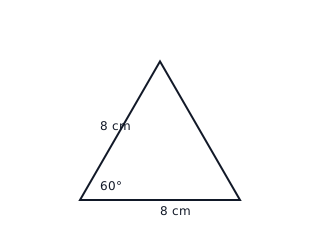
An equilateral triangle has a side length of . Calculate its area using the sine formula, giving your answer in the form .
Solution:
- In an equilateral triangle, all internal angles are .
- Identify the sides: and .
- Identify the included angle: .
- Apply the formula :
- Recall that :
- Final Area = .
Explanation:
Since all angles in an equilateral triangle are , we can use any two sides and the angle between them in the sine area formula.
Problem 5:
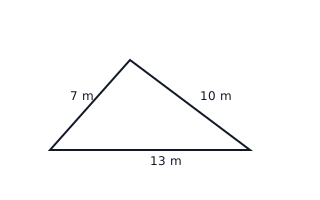
A triangular garden plot has sides of , , and . Find the area of the garden plot to two decimal places.
Solution:
- Use Heron's Formula. First, find the semi-perimeter :
- Substitute into the area formula:
- Calculate the product:
- Evaluate the square root:
- Area = .
Explanation:
When three sides are given without angles, Heron's Formula is the most direct method to find the area.