
Review the key concepts, formulae, and examples before starting your quiz.
🔑Concepts
The gradient (slope) of a straight line, denoted by , measures the steepness and direction. It is calculated as the change in (vertical rise) divided by the change in (horizontal run).
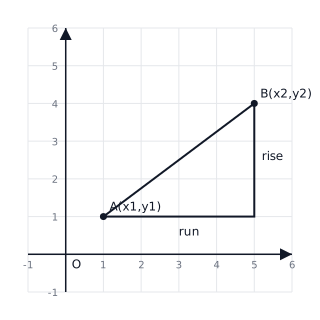
Straight lines can be represented in different forms: Gradient-intercept form , Point-gradient form , and General form .
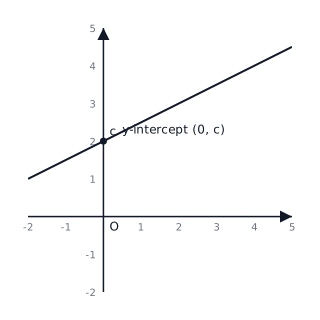
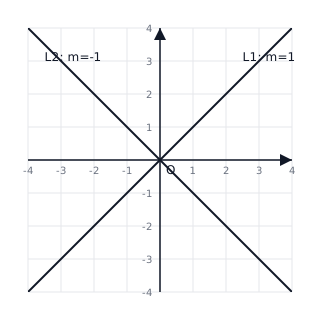
Parallel lines have identical gradients (), meaning they never intersect. Perpendicular lines intersect at and their gradients are negative reciprocals ().
The midpoint of a line segment is the average of the coordinates of the endpoints, while the distance is the length of the segment calculated using the Pythagorean theorem.
📐Formulae
💡Examples
Problem 1:
Find the equation of the line passing through the points and . Give your answer in the form .
Solution:
- Calculate the gradient:
- Use the point-gradient form with point :
- Expand and simplify:
Explanation:
First, the gradient is found using the formula. Then, we substitute one point and the gradient into the line equation and solve for to reach the gradient-intercept form.
Problem 2:
Line has the equation . Line is perpendicular to and passes through the point . Find the equation of .
Solution:
- Identify the gradient of : .
- Find the perpendicular gradient:
- Use the point-gradient form:
- Distribute the gradient:
- Add 2 to both sides:
Explanation:
Perpendicular lines have gradients that multiply to . Since has a gradient of , must have a gradient of . We then use the given point to determine the specific line equation.
Problem 3:
Calculate the distance between the points and .
Solution:
- Apply the distance formula:
- Simplify inside the parentheses:
- Square the numbers:
- Calculate the sum and square root:
Explanation:
The distance formula measures the length of the interval between two coordinates. Here, the horizontal difference is and the vertical difference is , leading to a distance of units.
Problem 4:
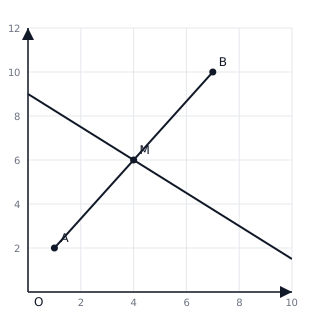
Points and form a diameter of a circle. Find the equation of the perpendicular bisector of the segment .
Solution:
- Find the midpoint of :
- Find the gradient of :
- Find the perpendicular gradient:
- Use the point-gradient formula with : or
Explanation:
A perpendicular bisector must pass through the midpoint of the segment and have a gradient that is the negative reciprocal of the segment's gradient.
Problem 5:
A line passes through the point and has a gradient of . A second line passes through the point and is perpendicular to . Find the point of intersection between and .
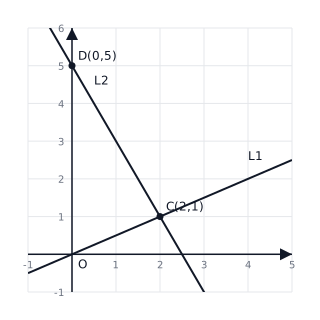
Solution:
Step 1: Find the equation of using .
Step 2: Find the gradient of . Since , .
Step 3: Find the equation of using point and .
Step 4: Solve the simultaneous equations to find the intersection.
Step 5: Substitute into .
The intersection point is .
Explanation:
To find the intersection of two lines, we first determine their individual equations. For , we use the point-slope form. For , we utilize the property that perpendicular lines have negative reciprocal gradients. Finally, we set the two equations equal to each other to solve for the shared and coordinates.