
Review the key concepts, formulae, and examples before starting your quiz.
🔑Concepts
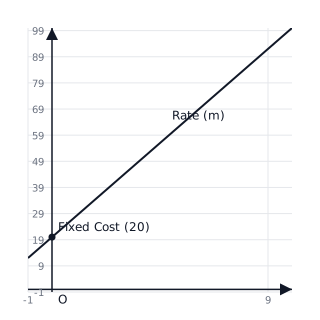
Modelling involves choosing a function to represent a real-world relationship. Linear models, , are used when there is a constant rate of change. The gradient represents the rate of change (e.g., speed or cost per unit), and the -intercept represents the initial value (e.g., starting height or fixed fee).
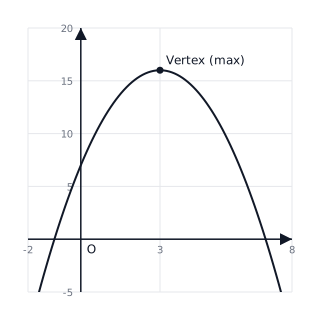
Quadratic models, , represent situations involving acceleration, projectile motion, or area optimization. The vertex identifies the maximum or minimum point of the model, which is critical for optimization problems.
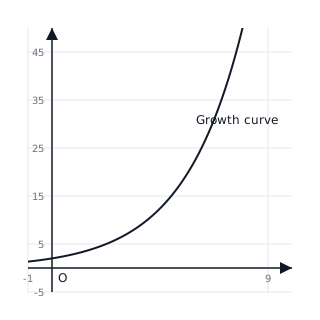
Exponential models, , represent rapid growth () or decay (), such as population growth, radioactive decay, or compound interest. The horizontal asymptote (usually if not shifted) indicates a limit that the value approaches over time.
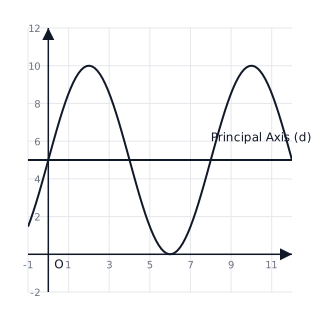
Sinusoidal (Periodic) models, , are used for phenomena that repeat over a set interval, such as tides, sound waves, or Ferris wheels. Parameters define the amplitude (), period ( or ), phase shift (), and vertical shift or principal axis ().
📐Formulae
💡Examples
Problem 1:
A plumber charges a fixed call-out fee of plus an hourly rate of . Write a linear model for the total cost in terms of hours worked, and calculate the cost for hours.
Solution:
For :
Explanation:
The fixed fee represents the y-intercept () and the hourly rate represents the gradient (). The total cost is units of currency.
Problem 2:
The height (in meters) of a ball thrown into the air is modelled by , where is the time in seconds. Find the maximum height reached by the ball.
Solution:
The maximum height occurs at the vertex. The time is: Substitute into the function:
Explanation:
The maximum of a downward-opening parabola is found at its vertex. The -coordinate of the vertex gives the time, and the -coordinate gives the maximum height.
Problem 3:
The population of a city is and is growing at a rate of per year. Write an exponential model for the population after years.
Solution:
The initial value . The growth factor .
Explanation:
Exponential growth models use the formula where is the decimal growth rate.
Problem 4:
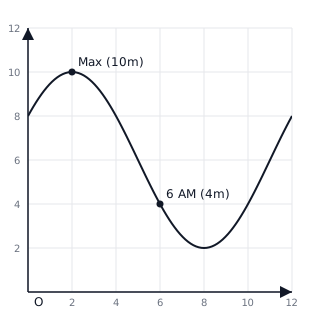
The water level (in meters) in a harbor varies periodically with time (in hours after midnight). The model is given by . Find the water level at AM and state the maximum depth of the water.
Solution:
- To find the level at AM, substitute into the equation: Since :
- The maximum depth is found at the peak of the cosine wave, which is the vertical shift plus the amplitude :
Explanation:
This is a periodic model. The cosine function oscillates between and . Multiplied by the amplitude (), it oscillates between and . Adding the vertical shift () moves the center of the oscillation to , resulting in a range of .
Problem 5:
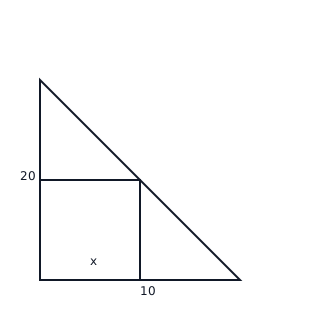
A rectangle is inscribed inside a right-angled triangle with a base of cm and a height of cm. If the width of the rectangle is , show that the area is given by . Find the value of that maximizes the area.
Solution:
- Using similar triangles, the height of the rectangle relates to as:
- The area :
- This is a quadratic with and . The maximum occurs at the vertex:
Explanation:
By expressing the dimensions of the rectangle in terms of a single variable using geometric properties (similar triangles), we create a quadratic function for the area. Finding the vertex of this parabola identifies the optimal width for the largest possible area.