
Review the key concepts, formulae, and examples before starting your quiz.
🔑Concepts
A function is a relation that maps each input (domain) to exactly one output (range). The notation indicates that the function takes input and produces output . This can be visualized as a mapping diagram where arrows connect elements of the domain to the range.

The domain is the set of all possible input values for which the function is defined. The range is the set of all actual output values. In a graph, the domain is represented along the horizontal -axis and the range along the vertical -axis.
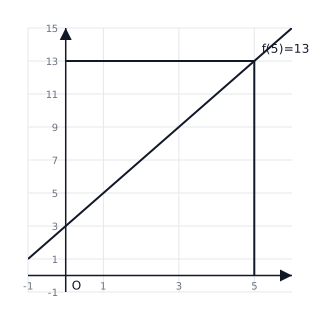
Function notation is used to evaluate functions at specific points. For a given expression like , finding involves substituting every instance of with . This corresponds to finding the -coordinate of a point on the graph where the -coordinate is .
Composite functions, written as or , represent a process where the output of function becomes the input for function . This is a two-step transformation sequence.
📐Formulae
💡Examples
Problem 1:
Given the function , calculate the value of .
Solution:
Explanation:
Substitute the value into every instance of in the function expression and simplify using the order of operations.
Problem 2:
If and , find the expression for .
Solution:
Explanation:
To find the composite function , substitute the entire expression of into the function in place of .
Problem 3:
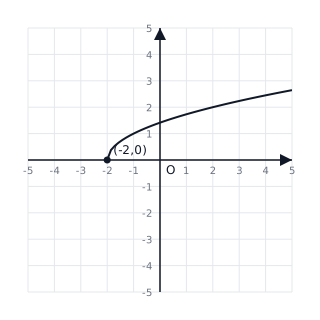
Determine the domain and range of the function .
Solution:
Domain: Range: Since , then
Explanation:
For the domain, the value inside the square root must be non-negative. For the range, we consider the minimum possible value of the square root term (which is ) and add the constant vertical shift.
Problem 4:
A linear function passes through the points and . Determine the value of .
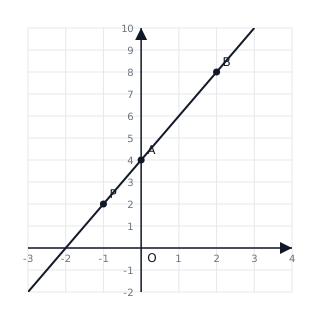
Solution:
- Find the gradient :
- Use the -intercept , which means . Thus, .
- Evaluate :
Explanation:
The function is established by finding the slope and intercept from the given coordinates. Once the general expression is known, any input can be substituted to find the corresponding output.
Problem 5:
Given the function , find the values of for which .
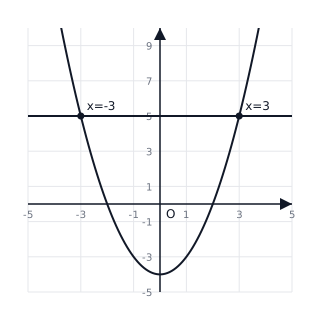
Solution:
- Set the function expression equal to 5:
- Add 4 to both sides:
- Take the square root of both sides:
- Result: or .
Explanation:
This problem asks for the inputs (domain elements) that map to a specific output (range element). Graphically, this is where the horizontal line intersects the curve .