
Review the key concepts, formulae, and examples before starting your quiz.
🔑Concepts
A function is a relation where every input in the domain corresponds to exactly one output in the range. Visually, this means a vertical line drawn anywhere on the graph of a function will cross the graph at most once (the Vertical Line Test).
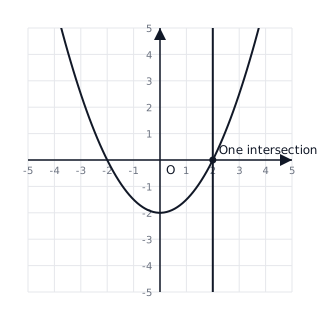
The domain is the set of all possible input values (-values) for which the function is defined. Restrictions typically arise from denominators (cannot be zero) and square roots (radicand must be non-negative).
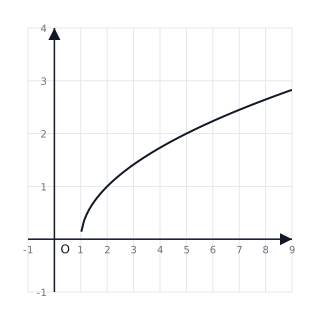
The range is the set of all resulting output values (-values). It represents the vertical extent of the graph.
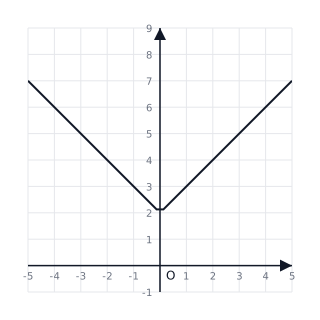
Function notation represents the value of the function at a specific . Mapping diagrams can visualize how elements from Set A (domain) relate to Set B (codomain).

📐Formulae
strips the relation into input and output .
💡Examples
Problem 1:
Given the function , find the value of .
Solution:
Explanation:
To evaluate the function, substitute the value into every instance of in the algebraic expression and simplify using the order of operations.
Problem 2:
Determine the domain of the function .
Solution:
For the function to be defined:
- The denominator cannot be zero:
- The value inside the square root must be non-negative: Combining these: . Domain:
Explanation:
In a rational function, the denominator cannot be zero. In a square root function, the radicand must be greater than or equal to zero. Since the root is in the denominator, it must be strictly greater than zero.
Problem 3:
If and , find .
Solution:
Step 1: Find Step 2: Find , which is So, .
Explanation:
In a composite function, evaluate the inner function first. Use the output of as the input for the function .
Problem 4:
Determine the range of the function by sketching its graph.
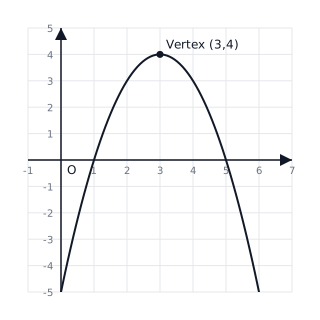
Solution:
- Identify the vertex: The function is in vertex form , so the vertex is .
- Determine the direction: Since , the parabola opens downwards.
- Identify the maximum value: The highest point on the graph is .
- State the range: The range is all real numbers less than or equal to 4, or .
Explanation:
The range of a downward-opening parabola is limited by its vertex's y-coordinate. All values below this peak are reachable.
Problem 5:
Find the domain of the rational function and identify its vertical asymptote.
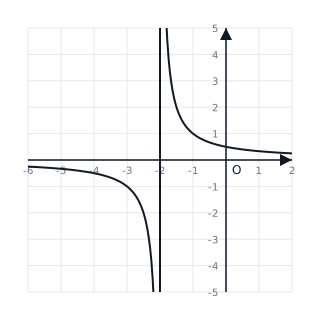
Solution:
- Set the denominator to zero: .
- Solve for : .
- State the domain: The function is undefined at , so the domain is .
- Identify the asymptote: The vertical line is where the function approaches infinity, representing a vertical asymptote.
Explanation:
In rational functions, the values that make the denominator zero are excluded from the domain and typically form vertical asymptotes.