krit.club logo

Functions - Composite and inverse functions (HL)

Grade 12IB_AI

Review the key concepts, formulae, and examples before starting your quiz.

🔑Concepts

•

A composite function (f∘g)(x)(f \circ g)(x) is formed when the output of one function g(x)g(x) becomes the input for another function f(x)f(x). The domain of the composite function is restricted to values of xx in the domain of gg such that g(x)g(x) is in the domain of ff.

•

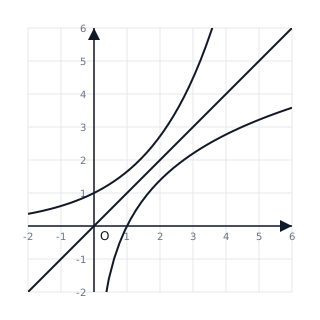
The inverse function f−1(x)f^{-1}(x) 'reverses' the action of f(x)f(x). A function has an inverse if and only if it is a one-to-one (injective) function. Graphically, the graph of y=f−1(x)y = f^{-1}(x) is a reflection of y=f(x)y = f(x) in the line y=xy = x.

Graph showing f(x) and its inverse reflected across the line y=x.
•

The domain of ff is equal to the range of f−1f^{-1}, and the range of ff is equal to the domain of f−1f^{-1}. This relationship is fundamental for identifying the valid inputs and outputs for inverse operations.

•

To find f−1(x)f^{-1}(x) algebraically, swap the variables xx and yy in the equation y=f(x)y = f(x) and solve for yy.

📐Formulae

(f∘g)(x)=f(g(x))(f \circ g)(x) = f(g(x))

f(f−1(x))=xf(f^{-1}(x)) = x

f−1(f(x))=xf^{-1}(f(x)) = x

y=f(x)  ⟺  x=f−1(y)y = f(x) \iff x = f^{-1}(y)

💡Examples

Problem 1:

Given f(x)=2x+5f(x) = 2x + 5 and g(x)=x2−3g(x) = x^2 - 3, find the composite function (g∘f)(x)(g \circ f)(x) and evaluate (g∘f)(1)(g \circ f)(1).

Solution:

(g∘f)(x)=g(f(x))=g(2x+5)(g \circ f)(x) = g(f(x)) = g(2x + 5) (g∘f)(x)=(2x+5)2−3(g \circ f)(x) = (2x + 5)^2 - 3 (g∘f)(x)=4x2+20x+25−3=4x2+20x+22(g \circ f)(x) = 4x^2 + 20x + 25 - 3 = 4x^2 + 20x + 22 To evaluate at x=1x = 1: (g∘f)(1)=4(1)2+20(1)+22=4+20+22=46(g \circ f)(1) = 4(1)^2 + 20(1) + 22 = 4 + 20 + 22 = 46

Explanation:

To find the composite function g(f(x))g(f(x)), substitute the entire expression for f(x)f(x) into every xx in the function g(x)g(x). Then simplify the resulting expression.

Problem 2:

Find the inverse function f−1(x)f^{-1}(x) for the function f(x)=3x−1x+2f(x) = \frac{3x - 1}{x + 2}, where x≠−2x \neq -2.

Solution:

  1. Let y=3x−1x+2y = \frac{3x - 1}{x + 2}
  2. Swap xx and yy: x=3y−1y+2x = \frac{3y - 1}{y + 2}
  3. Multiply by (y+2)(y + 2): x(y+2)=3y−1x(y + 2) = 3y - 1 xy+2x=3y−1xy + 2x = 3y - 1
  4. Rearrange to isolate yy: xy−3y=−2x−1xy - 3y = -2x - 1 y(x−3)=−(2x+1)y(x - 3) = -(2x + 1) y=−(2x+1)x−3=2x+13−xy = \frac{-(2x + 1)}{x - 3} = \frac{2x + 1}{3 - x}
  5. Therefore, f−1(x)=2x+13−xf^{-1}(x) = \frac{2x + 1}{3 - x}, x≠3x \neq 3.

Explanation:

To find the inverse algebraically, replace f(x)f(x) with yy, interchange xx and yy, and then solve the resulting equation for yy in terms of xx.

Problem 3:

A function h(x)h(x) has a domain D={x∈R:x≥0}D = \{x \in \mathbb{R} : x \geq 0\} and range R={y∈R:y≥5}R = \{y \in \mathbb{R} : y \geq 5\}. State the domain and range of h−1(x)h^{-1}(x).

Solution:

Domain of h−1=Range of h={x∈R:x≥5}h^{-1} = \text{Range of } h = \{x \in \mathbb{R} : x \geq 5\} Range of h−1=Domain of h={y∈R:y≥0}h^{-1} = \text{Domain of } h = \{y \in \mathbb{R} : y \geq 0\}

Explanation:

Because the inverse function reflects the original function over y=xy=x, the sets for the domain and range are swapped.

Problem 4:

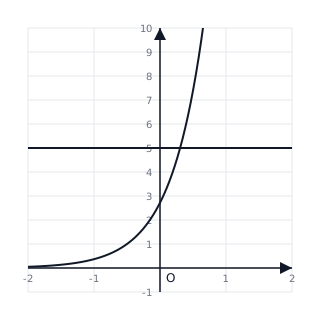
Given the functions f(x)=exf(x) = e^x and g(x)=2x+1g(x) = 2x + 1, find the expression for (f∘g)(x)(f \circ g)(x) and determine the value of xx for which (f∘g)(x)=5(f \circ g)(x) = 5.

Graph showing the intersection of the composite function y = e^(2x+1) and the horizontal line y = 5.

Solution:

  1. Find the composite expression: (f∘g)(x)=f(g(x))=f(2x+1)=e2x+1(f \circ g)(x) = f(g(x)) = f(2x + 1) = e^{2x + 1}
  2. Set the expression equal to 5: e2x+1=5e^{2x + 1} = 5
  3. Take the natural logarithm of both sides: ln⁡(e2x+1)=ln⁡(5)\ln(e^{2x + 1}) = \ln(5) 2x+1=ln⁡(5)2x + 1 = \ln(5)
  4. Solve for xx: 2x=ln⁡(5)−12x = \ln(5) - 1 x=ln⁡(5)−12≈0.305x = \frac{\ln(5) - 1}{2} \approx 0.305

Explanation:

The composition involves substituting the linear function g(x)g(x) into the exponent of the natural exponential function f(x)f(x). The resulting equation is solved using logarithms.

Problem 5:

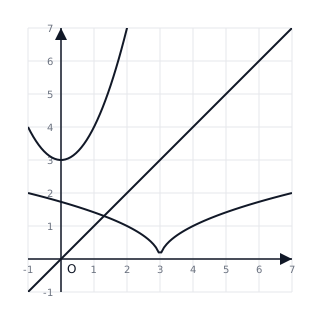
Consider the function f(x)=x−3f(x) = \sqrt{x - 3} for x≥3x \geq 3. Find the inverse function f−1(x)f^{-1}(x) and state its domain.

Graph of the square root function starting at (3,0) and its inverse, the right side of a parabola starting at (0,3).

Solution:

  1. Write the function as yy: y=x−3y = \sqrt{x - 3}
  2. Swap xx and yy: x=y−3x = \sqrt{y - 3}
  3. Solve for yy: Square both sides: x2=y−3x^2 = y - 3 y=x2+3y = x^2 + 3 So, f−1(x)=x2+3f^{-1}(x) = x^2 + 3.
  4. Determine the domain: The range of f(x)=x−3f(x) = \sqrt{x - 3} is y≥0y \geq 0. Therefore, the domain of f−1(x)f^{-1}(x) is x≥0x \geq 0.

Explanation:

To find the inverse, we isolate the variable that was originally the input. Because the original function's output is always non-negative (square root), the inverse function is only defined for x≥0x \geq 0.