
Review the key concepts, formulae, and examples before starting your quiz.
🔑Concepts
An exponential function is of the form , where is the initial scale factor (when ), is the base (growth/decay factor), and is the horizontal asymptote.
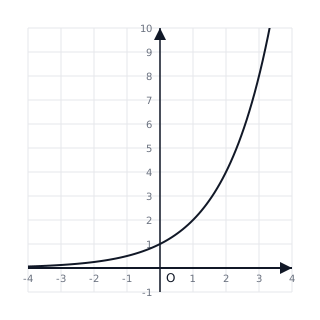
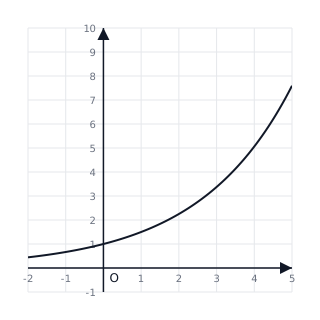
Exponential Growth occurs when , resulting in a curve that increases rapidly as increases. This is commonly used for population growth or compound interest calculations.
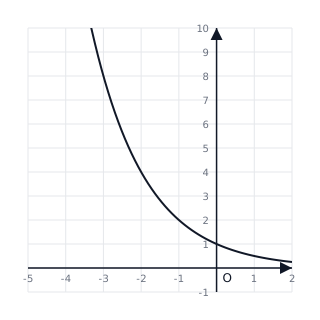
Exponential Decay occurs when , resulting in a curve that decreases towards the horizontal asymptote. This models radioactive decay or depreciation of assets.
The Natural Exponential Function uses the base . It is used in continuous growth models of the form , where is the continuous growth rate.
📐Formulae
💡Examples
Problem 1:
The population of a city is modeled by the function , where is the number of years after 2010. Find the population in 2025 and determine the annual percentage growth rate.
Solution:
- Identify the time interval: years.
- Substitute into the function:
- Identify the growth rate from the base :
Explanation:
To find the value at a specific time, we substitute the value of . The base represents a increase per year because .
Problem 2:
An exponential function passes through the points and . Find the equation in the form .
Solution:
- Use the point to find : Since , .
- Use the point and the value of to find :
- Write the final equation:
Explanation:
The -intercept directly gives the initial value when there is no vertical shift. We then solve for the base using the second coordinate.
Problem 3:
A car is purchased for 25000 and depreciates at a rate of per year. Write an expression for the value of the car after years and find its value after 5 years.
Solution:
- Identify the parameters: and .
- Calculate the decay factor :
- Formulate the equation:
- Calculate for :
Explanation:
Depreciation is modeled as exponential decay. The base is . The value after 5 years is calculated by raising the base to the power of 5 and multiplying by the initial price.
Problem 4:
A bacteria culture starts with 500 individuals and doubles every 3 hours. Find the function for the number of bacteria after hours, and determine how many bacteria are present after 12 hours.
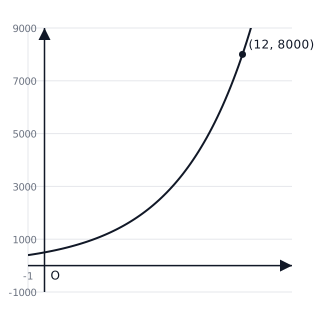
Solution:
- The general form is , where is the doubling period.
- Here, , , and .
- Equation:
- For : After 12 hours, there are 8000 bacteria.
Explanation:
To model doubling time, we use the base and divide the time by the duration it takes to double. Substituting the known values into this power function gives the total count.
Problem 5:
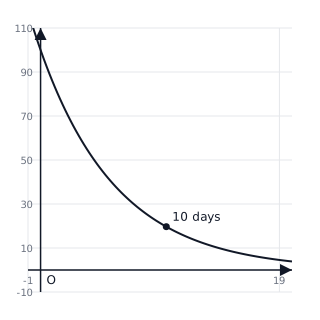
A radioactive substance has an initial mass of 100g and decays such that its mass after days is given by . Identify the daily percentage decay rate and find the mass remaining after 10 days.
Solution:
- The base .
- Decay rate : .
- Calculate mass for : The daily decay rate is and the remaining mass is .
Explanation:
The base represents the proportion remaining; subtracting this from 1 gives the proportion lost (decay rate). We use the power of 10 to find the substance remaining after 10 full decay periods.