
Review the key concepts, formulae, and examples before starting your quiz.
🔑Concepts
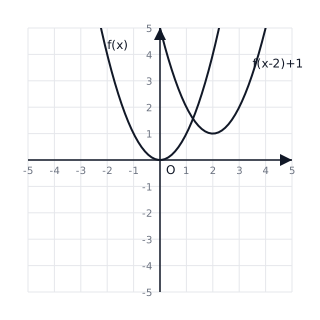
Vertical and Horizontal Translations: A vertical translation moves the graph up or down, represented by . A horizontal translation moves the graph left or right, represented by . Note that a positive moves the graph to the right, while a negative moves it to the left.
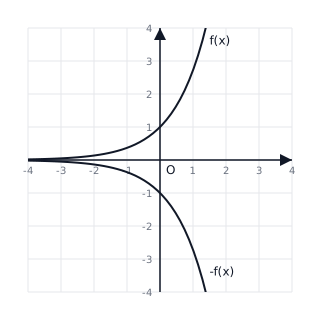
Reflections: A reflection in the -axis occurs when the entire function is multiplied by , expressed as . A reflection in the -axis occurs when the input variable is replaced by , expressed as .
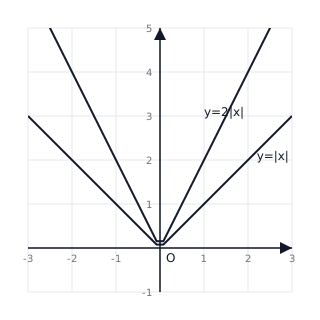
Vertical Stretching and Compression: Multiplying the function by a constant results in a vertical stretch by factor if , or a vertical compression if . All -coordinates are multiplied by , while -coordinates remain unchanged.
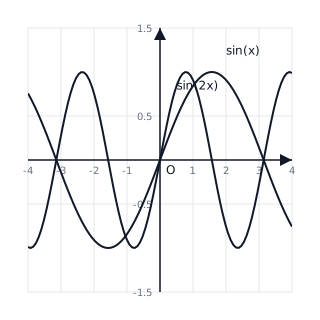
Horizontal Stretching and Compression: Multiplying the input by a constant results in a horizontal stretch by factor if , or a horizontal compression if . This transformation affects the -intercepts and widths of features.
📐Formulae
💡Examples
Problem 1:
Given the function , describe the transformations required to obtain the graph of .
Solution:
- Horizontal translation left by units ().
- Vertical stretch by a scale factor of ().
- Vertical translation down by units ().
Explanation:
In the form , we identify (since it is ), , and .
Problem 2:
A point lies on the graph of . Find the coordinates of the corresponding point on the graph of .
Solution:
Therefore, .
Explanation:
The transformation is a horizontal stretch with scale factor , so we divide the -coordinate by . The is a vertical translation, so we add to the -coordinate.
Problem 3:
The function is reflected in the -axis and then translated units to the right. Write the equation of the resulting function .
Solution:
Explanation:
Reflection in the -axis changes to . Translation units right replaces with , resulting in .
Problem 4:
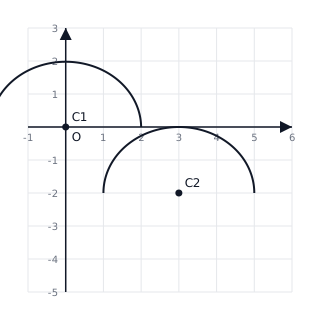
The graph of is shown below as a semi-circle centered at the origin with radius . Sketch the graph of and state the new center of the semi-circle.
Solution:
- Identify the transformations: is a horizontal translation units to the right. is a vertical translation units down.
- The original center is at . Applying the translations, the new center becomes .
- The radius remains . The domain of the original function was ; the new domain is . The range of the original was ; the new range is .
Explanation:
To transform the graph, move every point on the original semi-circle units to the right and units down.
Problem 5:
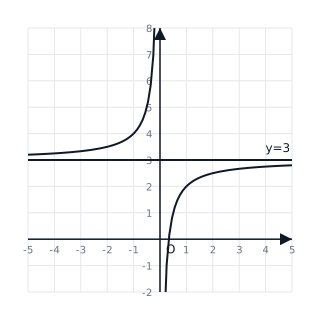
Consider the function . If , describe the sequence of transformations and sketch the resulting graph including the horizontal asymptote.
Solution:
- The transformation is a reflection in the -axis.
- The transformation is a vertical translation units up.
- Original horizontal asymptote: . New horizontal asymptote: .
- Original vertical asymptote: . Reflection in -axis leaves this unchanged at .
Explanation:
Applying a reflection in the -axis to results in . Moving this up by 3 units shifts the entire structure, including the horizontal asymptote, to .