
Review the key concepts, formulae, and examples before starting your quiz.
🔑Concepts
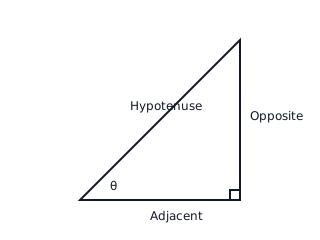
The Sine, Cosine, and Tangent ratios (SOH CAH TOA) define the relationships between the sides and angles of a right-angled triangle. The hypotenuse is the longest side, opposite the angle; the opposite side is across from the reference angle , and the adjacent side is next to it.
The Sine Rule is used for non-right-angled triangles when we know a side and its opposite angle, plus one other piece of information (AAS or SSA).
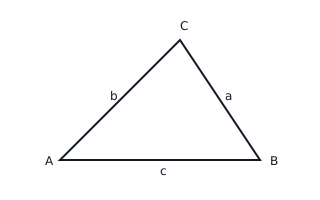
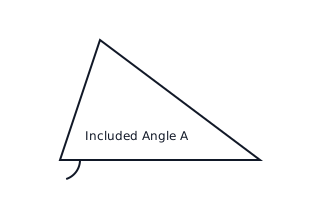
The Cosine Rule is used for finding a side when two sides and the included angle are known (SAS), or for finding an angle when three sides are known (SSS).
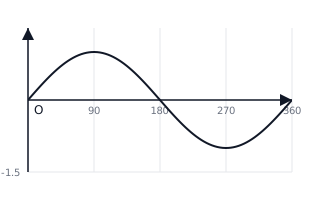
Trigonometric graphs for , , and are periodic. The sine and cosine functions have a period of and range between and .
📐Formulae
💡Examples
Problem 1:
In a right-angled triangle ABC, the hypotenuse AC is 12 cm and angle BAC is 35°. Calculate the length of the side BC.
Solution:
BC = cm
Explanation:
Identify that BC is the opposite side to the given angle and AC is the hypotenuse. Use the sine ratio: . Multiply both sides by 12 to solve for BC.
Problem 2:
In triangle PQR, PQ = 7 cm, QR = 10 cm, and PR = 8 cm. Find the size of angle QPR.
Solution:
;
Explanation:
Since all three sides of a non-right triangle are known, use the Cosine Rule rearranged for the angle: .
Problem 3:
Calculate the area of a triangle where two sides are 5 cm and 9 cm, and the included angle is 42°.
Solution:
Area = cm²
Explanation:
Use the formula for the area of a triangle when two sides and the included angle (SAS) are known: .
Problem 4:
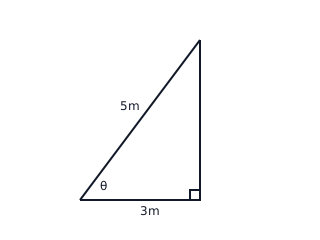
A ladder 5 m long leans against a vertical wall. The base of the ladder is 3 m from the wall. Calculate the angle that the ladder makes with the ground.
Solution:
Explanation:
We identify the sides relative to the angle between the ladder and the ground. The ladder length is the hypotenuse ( m) and the distance from the wall is the adjacent side ( m). We use the Cosine ratio (CAH).
Problem 5:
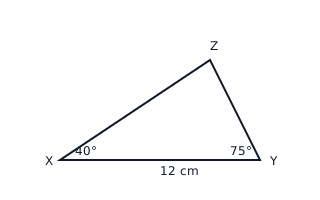
In triangle XYZ, cm, angle , and angle . Calculate the length of side YZ.
Solution:
First find the third angle : Use Sine Rule to find ():
Explanation:
Since we have two angles and a side, we first find the angle opposite the known side. Then, we apply the Sine Rule to solve for the unknown side .