krit.club logo

Trigonometry - Area of a triangle (1/2 ab sin C)

Grade 11A Level

Review the key concepts, formulae, and examples before starting your quiz.

🔑Concepts

•

The area of any triangle can be calculated if two sides and the included angle (the angle between the two sides) are known. This is particularly useful for non-right-angled triangles where the perpendicular height is not given.
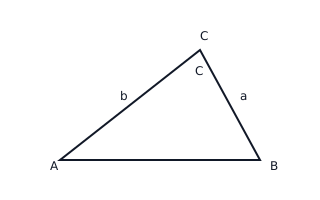
A triangle ABC showing sides a and b with the included angle C.
•

The formula Area=12absin⁡C\text{Area} = \frac{1}{2}ab \sin C is derived from the basic triangle area formula Area=12×base×height\text{Area} = \frac{1}{2} \times \text{base} \times \text{height}. By using trigonometry, the height hh can be expressed as h=bsin⁡Ah = b \sin A or h=asin⁡Bh = a \sin B depending on the orientation.

•

When solving for an unknown angle given the area, remember that sin⁡θ=sin⁡(180∘−θ)\sin \theta = \sin(180^\circ - \theta). If the question does not specify if the angle is acute or obtuse, there may be two possible solutions.

•

The units for the area will be the square of the linear units provided for the sides (e.g., cm2\text{cm}^2, m2\text{m}^2). Ensure all side lengths are in the same units before calculation.

📐Formulae

Area=12absin⁡C\text{Area} = \frac{1}{2} ab \sin C

Area=12bcsin⁡A\text{Area} = \frac{1}{2} bc \sin A

Area=12acsin⁡B\text{Area} = \frac{1}{2} ac \sin B

💡Examples

Problem 1:

In triangle ABC, side a=8 cma = 8\text{ cm}, side b=11 cmb = 11\text{ cm}, and the included angle C=35∘C = 35^\circ. Calculate the area of the triangle correct to 3 significant figures.

Solution:

Area=12×8×11×sin⁡(35∘)≈25.237...≈25.2 cm2\text{Area} = \frac{1}{2} \times 8 \times 11 \times \sin(35^\circ) \approx 25.237... \approx 25.2\text{ cm}^2

Explanation:

Substitute the known values a=8a=8, b=11b=11, and C=35C=35 directly into the formula 12absin⁡C\frac{1}{2}ab \sin C and evaluate using a calculator.

Problem 2:

The area of a triangle PQR is 40 cm240\text{ cm}^2. Given that PQ=10 cmPQ = 10\text{ cm} and QR=12 cmQR = 12\text{ cm}, find the size of the acute angle QQ.

Solution:

40=12×10×12×sin⁡Q⇒40=60sin⁡Q⇒sin⁡Q=4060=23⇒Q=arcsin⁡(23)≈41.8∘40 = \frac{1}{2} \times 10 \times 12 \times \sin Q \Rightarrow 40 = 60 \sin Q \Rightarrow \sin Q = \frac{40}{60} = \frac{2}{3} \Rightarrow Q = \arcsin(\frac{2}{3}) \approx 41.8^\circ

Explanation:

Rearrange the area formula to solve for the missing angle: sin⁡Q=2×Areap×r\sin Q = \frac{2 \times \text{Area}}{p \times r}.

Problem 3:

Calculate the area of an equilateral triangle with side length 6 cm6\text{ cm}.

Solution:

Area=12×6×6×sin⁡(60∘)=18×32=93≈15.6 cm2\text{Area} = \frac{1}{2} \times 6 \times 6 \times \sin(60^\circ) = 18 \times \frac{\sqrt{3}}{2} = 9\sqrt{3} \approx 15.6\text{ cm}^2

Explanation:

In an equilateral triangle, all sides are equal (a=b=6a=b=6) and all angles are 60∘60^\circ.

Problem 4:

Calculate the area of triangle XYZXYZ where side x=7.4 cmx = 7.4\text{ cm}, side z=5.2 cmz = 5.2\text{ cm}, and angle Y=42∘Y = 42^\circ. Give your answer to 2 decimal places.
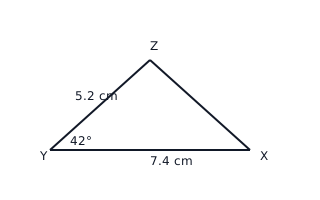
Triangle XYZ with side YX = 7.4, YZ = 5.2 and angle Y = 42 degrees.

Solution:

Area=12xzsin⁡Y\text{Area} = \frac{1}{2}xz \sin Y Area=12×7.4×5.2×sin⁡(42∘)\text{Area} = \frac{1}{2} \times 7.4 \times 5.2 \times \sin(42^\circ) Area=19.24×0.6691...\text{Area} = 19.24 \times 0.6691... Area≈12.87 cm2\text{Area} \approx 12.87\text{ cm}^2

Explanation:

Identify the two given sides and the included angle. Substitute x=7.4x=7.4, z=5.2z=5.2, and Y=42∘Y=42^\circ into the formula 12xzsin⁡Y\frac{1}{2}xz \sin Y. Use a calculator to find the sine value and compute the final product.

Problem 5:

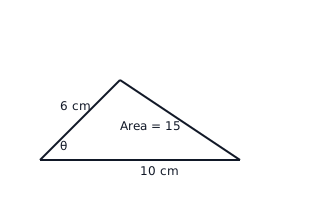
A triangle has an area of 15 cm215\text{ cm}^2. Two of its sides are 6 cm6\text{ cm} and 10 cm10\text{ cm}. Find the possible values of the included angle θ\theta between these two sides.

A triangle with sides 6 and 10 and included angle theta, labeled with area 15.

Solution:

Area=12absin⁡θ\text{Area} = \frac{1}{2}ab \sin \theta 15=12×6×10×sin⁡θ15 = \frac{1}{2} \times 6 \times 10 \times \sin \theta 15=30sin⁡θ15 = 30 \sin \theta sin⁡θ=1530=0.5\sin \theta = \frac{15}{30} = 0.5 θ=sin⁡−1(0.5)\theta = \sin^{-1}(0.5) θ=30∘ or θ=180∘−30∘=150∘\theta = 30^\circ \text{ or } \theta = 180^\circ - 30^\circ = 150^\circ

Explanation:

Substitute the known area and side lengths into the formula. Solve for sin⁡θ\sin \theta. Since the sine of an angle is positive in both the first and second quadrants, there are two possible angles: the acute angle 30∘30^\circ and the obtuse angle 150∘150^\circ.