
Review the key concepts, formulae, and examples before starting your quiz.
🔑Concepts
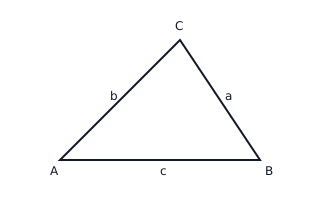
The Sine Rule connects the lengths of sides to the sines of their opposite angles. Use to find a missing side, and to find a missing angle. This rule is applied when you know a matching 'side-angle' pair and one other piece of information.
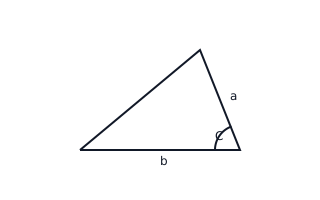
The Cosine Rule is used to find a third side when two sides and the included angle (SAS) are known. It is also used to find an angle when all three sides (SSS) are known, using the rearranged form .
Area of a non-right-angled triangle can be calculated using . This requires two sides and the angle between them (the 'included' angle).
The 'Ambiguous Case' occurs when using the Sine Rule with two sides and a non-included angle (SSA). There can be two possible triangles if the side opposite the given angle is shorter than the other given side but longer than the altitude.
📐Formulae
(Sine Rule for finding sides)
(Sine Rule for finding angles)
(Cosine Rule for finding sides)
(Cosine Rule for finding angles)
(Area of any triangle)
💡Examples
Problem 1:
In triangle ABC, side cm, angle , and angle . Calculate the length of side .
Solution:
cm
Explanation:
Since we have a side-angle pair ( and ) and want to find side given angle , we use the Sine Rule: .
Problem 2:
In triangle PQR, cm, cm, and cm. Find the size of angle .
Solution:
.
Explanation:
When three sides are given (SSS), use the Cosine Rule rearranged for the angle. Here, side is cm, and the adjacent sides are and .
Problem 3:
Find the area of a triangle where two sides are 5 cm and 9 cm, and the included angle is .
Solution:
cm²
Explanation:
Use the Area formula where and are the given sides and is the angle between them.
Problem 4:
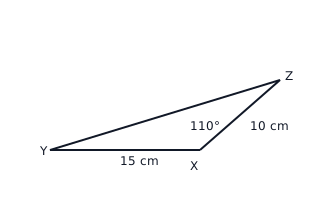
In triangle XYZ, cm, cm, and angle . Calculate the length of .
Solution:
- Identify the given information: Two sides and the included angle (SAS). Use the Cosine Rule.
- Let be the length of , cm, cm, and .
- Substitute into the formula:
- Calculate the values:
- The length of is cm (to 3 s.f.).
Explanation:
Since we are given two sides and the angle between them, the Cosine Rule is the most direct method to find the opposite side.
Problem 5:
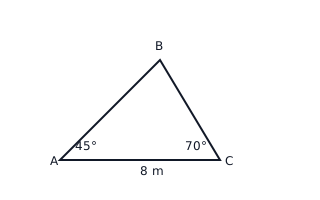
In triangle ABC, m, angle , and angle . Find the area of the triangle.
Solution:
- Find angle :
- Use the Sine Rule to find side (BC):
- Use the Area formula with sides , and included angle :
- The area is m (to 3 s.f.).
Explanation:
To find the area, we need two sides and the included angle. We calculated the third angle first, then used the Sine Rule to find a second side.