krit.club logo

Trigonometry - Bearings

Grade 11A Level

Review the key concepts, formulae, and examples before starting your quiz.

🔑Concepts

•

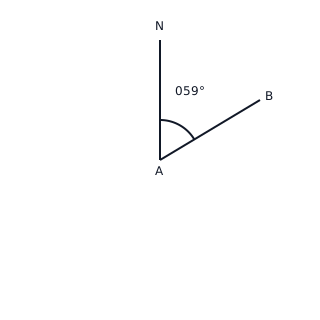
Bearings are measured from the North line in a clockwise direction and are always written using three digits (e.g., 045∘045^\circ instead of 45∘45^\circ).

Diagram showing a bearing of 059 degrees measured clockwise from North.
•

The bearing from AA to BB and the bearing from BB to AA (Back Bearing) differ by 180∘180^\circ. This relationship is based on the properties of parallel lines and co-interior angles.
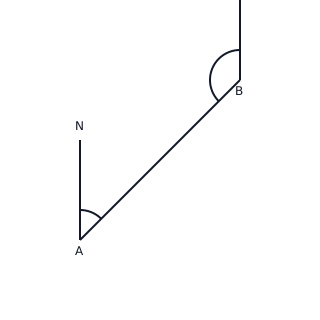
Diagram showing parallel north lines and the relationship between forward and back bearings.
•

In non-right-angled bearing problems, create a triangle and use the Sine Rule or Cosine Rule to find missing distances or angles.

•

Always draw a North line at every point mentioned in the problem to visualize the angles correctly.

📐Formulae

Back Bearing=θ±180∘\text{Back Bearing} = \theta \pm 180^\circ

Sine Rule:asin⁡A=bsin⁡B=csin⁡C\text{Sine Rule}: \frac{a}{\sin A} = \frac{b}{\sin B} = \frac{c}{\sin C}

Cosine Rule (Side):a2=b2+c2−2bccos⁡A\text{Cosine Rule (Side)}: a^2 = b^2 + c^2 - 2bc \cos A

Cosine Rule (Angle):cos⁡A=b2+c2−a22bc\text{Cosine Rule (Angle)}: \cos A = \frac{b^2 + c^2 - a^2}{2bc}

SOH CAH TOA (for right-angled triangles)\text{SOH CAH TOA (for right-angled triangles)}

💡Examples

Problem 1:

A ship sails 12 km on a bearing of 070° from port P to point A. It then sails 15 km on a bearing of 150° from A to point B. Calculate the distance PB.

Solution:

  1. Angle at A: The interior angle between the North line at P and the North line at A is 180−70=110∘180 - 70 = 110^\circ.
  2. The angle around point A includes the bearing of B (150°) and the interior angle. To find the internal angle ∠PAB\angle PAB: 360∘−110∘−(360−150)=…360^\circ - 110^\circ - (360 - 150) = \dots or more simply: Angle between South at A and AB is 150−180=−30150 - 180 = -30 (invalid), use: 180−(150−70)=100∘180 - (150-70) = 100^\circ or visualize: ∠PAB=(180−70)+150\angle PAB = (180 - 70) + 150 is not right. Correct logic: Angle at A relative to North is 70° (alternate). So angle inside triangle is 180−70+150180 - 70 + 150 is wrong. Correct: (180−70)=110(180 - 70) = 110. Bearing of B from A is 150. So ∠PAB=180−(150−70)=100∘\angle PAB = 180 - (150 - 70) = 100^\circ.
  3. Use Cosine Rule: PB2=122+152−2(12)(15)cos⁡(100∘)PB^2 = 12^2 + 15^2 - 2(12)(15)\cos(100^\circ).
  4. PB2=144+225−360(−0.1736)=369+62.5=431.5PB^2 = 144 + 225 - 360(-0.1736) = 369 + 62.5 = 431.5.
  5. PB=431.5≈20.8PB = \sqrt{431.5} \approx 20.8 km.

Explanation:

To solve complex bearings, always draw the North lines at every point. Use the 'Z-rule' (alternate angles) or interior angles to find the internal angle of the triangle formed, then apply the Cosine Rule for the unknown side.

Problem 2:

The bearing of a lighthouse L from a boat B is 240°. What is the bearing of the boat from the lighthouse?

Solution:

  1. Given Bearing B→L=240∘B \to L = 240^\circ.
  2. Since 240∘>180∘240^\circ > 180^\circ, subtract 180∘180^\circ.
  3. 240∘−180∘=060∘240^\circ - 180^\circ = 060^\circ.

Explanation:

This is a back-bearing problem. Since the North lines are parallel, the angles are related by 180 degrees. If you are looking at someone on a bearing of 240°, they are looking back at you on a bearing of 060°.

Problem 3:

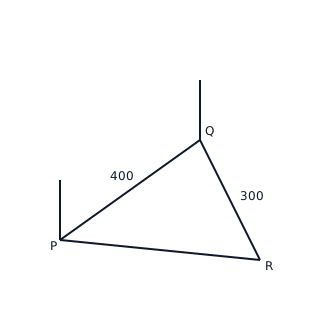
A plane flies from airport PP to airport QQ on a bearing of 065∘065^\circ. The distance PQPQ is 400400 km. It then flies from QQ to RR on a bearing of 155∘155^\circ. The distance QRQR is 300300 km. Find the distance PRPR.

Triangle PQR showing path of plane with bearings.

Solution:

The angle inside the triangle at Q=(180∘−65∘)+155∘ is incorrect logic.\text{The angle inside the triangle at } Q = (180^\circ - 65^\circ) + 155^\circ \text{ is incorrect logic.} Correct approach: The interior angle PQR=180∘−(155∘−65∘)=90∘\text{Correct approach: The interior angle } PQR = 180^\circ - (155^\circ - 65^\circ) = 90^\circ Using Pythagoras Theorem: PR2=4002+3002\text{Using Pythagoras Theorem: } PR^2 = 400^2 + 300^2 PR2=160000+90000=250000PR^2 = 160000 + 90000 = 250000 PR=250000=500 kmPR = \sqrt{250000} = 500 \text{ km}

Explanation:

By drawing North lines at PP and QQ, we find that the angle between PQPQ and the North line at QQ is 180∘−65∘=115∘180^\circ - 65^\circ = 115^\circ (co-interior). However, a simpler way is noticing the difference in bearings 155∘−65∘=90∘155^\circ - 65^\circ = 90^\circ, which forms a right-angled triangle.

Problem 4:

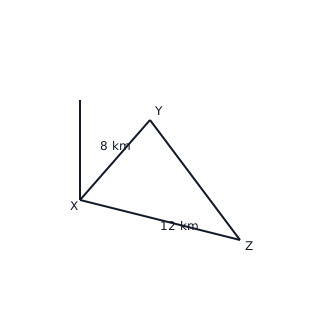
Point YY is 88 km from XX on a bearing of 040∘040^\circ. Point ZZ is 1212 km from XX on a bearing of 110∘110^\circ. Calculate the distance YZYZ.

Triangle XYZ where X is the origin point for two bearings.

Solution:

Angle YXZ=110∘−40∘=70∘\text{Angle } YXZ = 110^\circ - 40^\circ = 70^\circ Using the Cosine Rule: YZ2=82+122−2(8)(12)cos⁡(70∘)\text{Using the Cosine Rule: } YZ^2 = 8^2 + 12^2 - 2(8)(12) \cos(70^\circ) YZ2=64+144−192cos⁡(70∘)YZ^2 = 64 + 144 - 192 \cos(70^\circ) YZ2=208−192(0.342)YZ^2 = 208 - 192(0.342) YZ2=208−65.664=142.336YZ^2 = 208 - 65.664 = 142.336 YZ=142.336≈11.93 kmYZ = \sqrt{142.336} \approx 11.93 \text{ km}

Explanation:

Since we know two sides and the included angle (110∘−40∘110^\circ - 40^\circ), the Cosine Rule is used to find the third side.