
Review the key concepts, formulae, and examples before starting your quiz.
🔑Concepts
Pythagoras' Theorem applies specifically to right-angled triangles. The side opposite the right angle () is called the hypotenuse and is always the longest side. In a triangle with sides , , and hypotenuse , the relationship is .
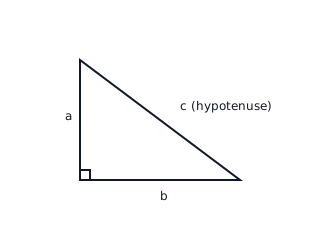
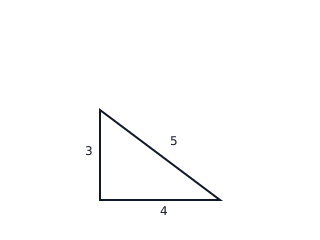
The converse of Pythagoras' Theorem states that if the sum of the squares of two sides equals the square of the third side (), then the triangle must be right-angled.
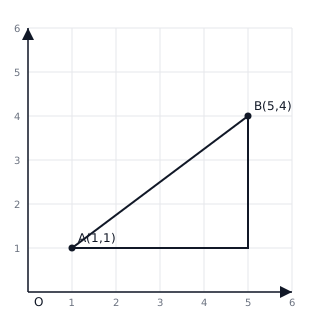
To find the distance between two points and on a Cartesian plane, we treat the horizontal and vertical differences as the legs of a right-angled triangle.
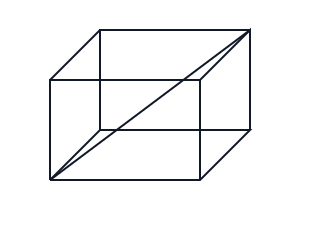
In 3D shapes like cuboids, Pythagoras' theorem can be applied twice to find the space diagonal: once to find the diagonal of the base, and then again using that result and the height.
📐Formulae
(where is the hypotenuse)
(finding the hypotenuse)
(finding a shorter side)
(3D Pythagoras for a space diagonal in a cuboid with dimensions )
(Distance between two points on a coordinate plane)
💡Examples
Problem 1:
A ladder of length 5m is leaned against a vertical wall. The base of the ladder is 3m away from the wall on horizontal ground. How high up the wall does the ladder reach?
Solution:
Let the height be . Using , we have . . . .
Explanation:
In this scenario, the ladder acts as the hypotenuse () and the distance from the wall is one of the shorter sides (). We rearrange the formula to solve for the missing vertical side .
Problem 2:
A triangle has side lengths of 7cm, 24cm, and 25cm. Determine if this triangle is right-angled.
Solution:
. The square of the longest side is . Since , the condition is satisfied.
Explanation:
To check for a right angle, square the two shorter sides and sum them. If the result equals the square of the longest side (the converse of Pythagoras' Theorem), the triangle is right-angled.
Problem 3:
Find the length of the internal diagonal of a cuboid with dimensions 3cm, 4cm, and 12cm.
Solution:
. cm.
Explanation:
In 3D Pythagoras, the squared length of the space diagonal is the sum of the squares of the length, width, and height. This is equivalent to applying Pythagoras twice: once to find the diagonal of the base, and then again to find the diagonal of the cuboid.
Problem 4:
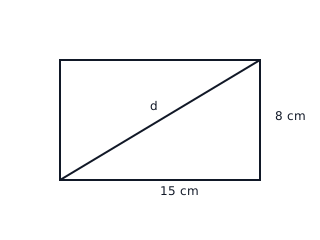
Calculate the length of the diagonal of a rectangle with a width of and a height of .
Solution:
Explanation:
A rectangle can be divided into two right-angled triangles by its diagonal. We use the side lengths and as and to solve for the hypotenuse (the diagonal).
Problem 5:
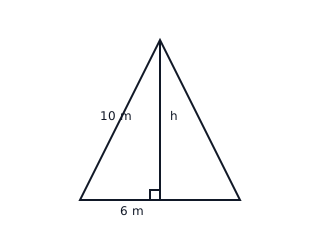
An isosceles triangle has a base of and two equal sides of . Find the perpendicular height of the triangle.
Solution:
Explanation:
In an isosceles triangle, the perpendicular height bisects the base. This creates two right-angled triangles with a base of () and a hypotenuse of . We then solve for the vertical leg.