
Review the key concepts, formulae, and examples before starting your quiz.
🔑Concepts
3D Trigonometry involves solving problems in three-dimensional shapes like cuboids, pyramids, and prisms by identifying right-angled triangles embedded within them. The first step is often to use the Pythagorean theorem in 2D to find a diagonal on the base before moving to a vertical triangle.
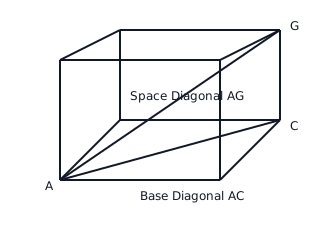
The angle between a line and a plane is the angle between the line and its projection on that plane. For example, the angle between space diagonal and base is .
For pyramids, the height always meets the base at its center (centroid). For a square-based pyramid, the height drops to the intersection of the diagonals of the square base.
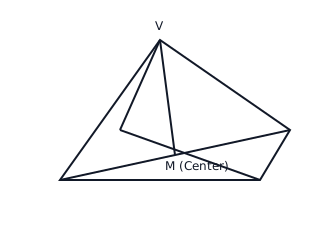
The angle between two planes (dihedral angle) is found by drawing two lines, one in each plane, that both meet the line of intersection at at the same point.
📐Formulae
Pythagoras in 3D:
Sine Rule:
Cosine Rule (Length):
Cosine Rule (Angle):
Basic Trig:
Area of a triangle:
💡Examples
Problem 1:
A cuboid has dimensions cm, cm, and height cm. Calculate the length of the space diagonal and the angle makes with the base .
Solution:
- Find diagonal of the base : cm.
- Find using : cm.
- Find angle : .
- .
Explanation:
To find the space diagonal, we first apply Pythagoras to the horizontal base to find . Then, we use the vertical triangle where is the base and is the height. The angle between the line and the base is the angle between the line and its projection on the base.
Problem 2:
A square-based pyramid has a base side of 10 cm and a vertical height of 12 cm. Find the angle between a sloping face and the base.
Solution:
- Let be the midpoint of one base edge and be the center of the base.
- The distance cm.
- The vertical height cm.
- In the right-angled , let the angle at be .
- .
- .
Explanation:
The angle between a sloping face and the base is measured along the line of greatest slope. We create a right-angled triangle using the vertical height of the pyramid, the distance from the center of the base to the midpoint of the edge, and the slant height of the face.
Problem 3:
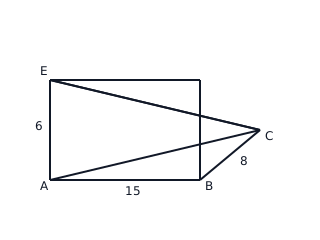
A triangular prism has a horizontal rectangular base where cm and cm. The vertical face is a rectangle with height cm. Calculate the length of the diagonal and the angle it makes with the base .
Solution:
-
Find (diagonal of the base) using Pythagoras:
-
Use (right-angled at ) to find :
-
Find the angle :
Explanation:
We first calculate the diagonal of the base to create a right-angled triangle that contains the space diagonal and the angle required.
Problem 4:
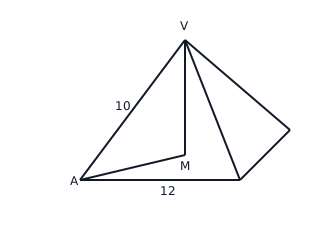
A right pyramid has a square base of side 12 cm. The sloping edges are all 10 cm long. Calculate the vertical height of the pyramid.
Solution:
-
Let the base be with center and vertex . Diagonal of the square base:
-
The distance from a corner to the center is half the diagonal:
-
In (right-angled at ):
Explanation:
To find the vertical height, we construct a right-angled triangle using the slant edge (hypotenuse) and the distance from the vertex center to the corner.