
Review the key concepts, formulae, and examples before starting your quiz.
🔑Concepts
The general form of a sinusoidal function is or . The value represents the amplitude, which is the vertical distance from the principal axis to the maximum or minimum value.
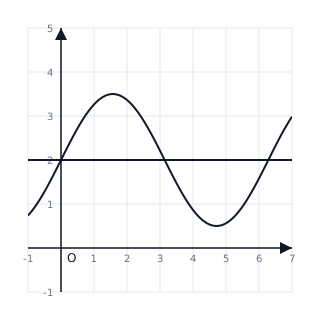
The period of the function is the horizontal length of one complete cycle. It is calculated as in radians or in degrees. The horizontal shift is controlled by the constant .
The principal axis is the horizontal line , which represents the average value of the function. It is halfway between the maximum and minimum values.
Sinusoidal functions are used to model periodic phenomena in the real world, such as tides, sound waves, and the rotation of wheels. In these models, the x-axis often represents time ().
📐Formulae
💡Examples
Problem 1:
Determine the amplitude, period, and principal axis for the function .
Solution:
- Compare with the general form .
- Identify . The amplitude is .
- Identify . The period is .
- Identify . The equation of the principal axis is .
Explanation:
The amplitude is the coefficient of the sine term. The period is calculated by dividing by the frequency coefficient . The constant term determines the vertical shift and the principal axis.
Problem 2:
A Ferris wheel has a maximum height of and a minimum height of . It takes to complete one full revolution. Find a cosine model for the height in terms of time , assuming the passenger starts at the bottom at .
Solution:
- Find amplitude :
- Find vertical shift :
- Find using the period :
- Since the passenger starts at the bottom (the minimum), we use a negative cosine graph:
Explanation:
The amplitude is half the range. The vertical shift is the average of the max and min. Because the motion starts at the minimum point rather than the maximum or the midline, a negative cosine function is the simplest way to model the starting position.
Problem 3:
Given the function , find the maximum and minimum values of the function.
Solution:
- The principal axis is and the amplitude is .
- Maximum value:
- Minimum value:
Explanation:
The maximum value is the principal axis plus the amplitude, and the minimum value is the principal axis minus the amplitude.
Problem 4:
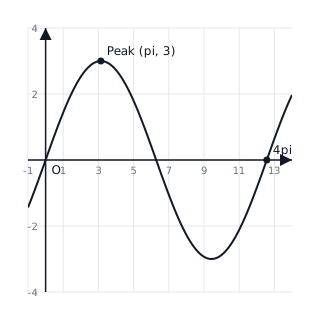
A periodic wave is modeled by the function . Identify the amplitude and the period (in radians), then sketch the function for one full cycle starting from .
Solution:
- Amplitude: The coefficient , so the amplitude is .
- Period: The coefficient . In radians, .
- Principal Axis: Since , the principal axis is (the x-axis).
- Range: The maximum value is and the minimum value is .
Explanation:
To sketch the graph, we start at the origin because it is a sine function with no horizontal shift. One full cycle ends at . The peak occurs at one-quarter of the period () and the trough at three-quarters ().
Problem 5:
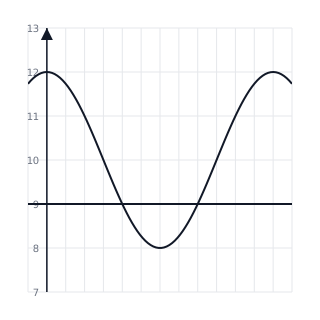
The depth of water in meters in a harbor varies according to the function , where is the number of hours after midnight. Find the depth at 2:00 AM and find the first time after midnight when the depth is exactly meters.
Solution:
- Depth at 2:00 AM: Substitute into the function: .
- Time when depth is 9m: Set : . So, the depth is at 4:00 AM.
Explanation:
The cosine function starts at its maximum value at . The vertical shift means the average depth is , and it fluctuates above and below this value.