
Review the key concepts, formulae, and examples before starting your quiz.
🔑Concepts
A composite function is formed when the output of one function becomes the input for another function . The domain of the composite function is restricted to values of in the domain of such that is in the domain of .
The inverse function 'reverses' the action of . A function has an inverse if and only if it is a one-to-one (injective) function. Graphically, the graph of is a reflection of in the line .
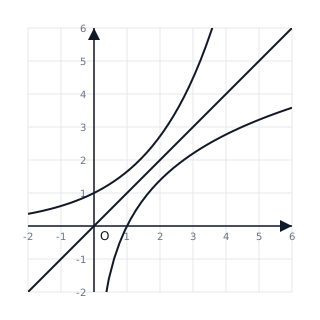
The domain of is equal to the range of , and the range of is equal to the domain of . This relationship is fundamental for identifying the valid inputs and outputs for inverse operations.
To find algebraically, swap the variables and in the equation and solve for .
📐Formulae
💡Examples
Problem 1:
Given and , find the composite function and evaluate .
Solution:
To evaluate at :
Explanation:
To find the composite function , substitute the entire expression for into every in the function . Then simplify the resulting expression.
Problem 2:
Find the inverse function for the function , where .
Solution:
- Let
- Swap and :
- Multiply by :
- Rearrange to isolate :
- Therefore, , .
Explanation:
To find the inverse algebraically, replace with , interchange and , and then solve the resulting equation for in terms of .
Problem 3:
A function has a domain and range . State the domain and range of .
Solution:
Domain of Range of
Explanation:
Because the inverse function reflects the original function over , the sets for the domain and range are swapped.
Problem 4:
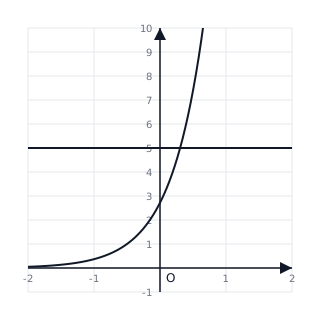
Given the functions and , find the expression for and determine the value of for which .
Solution:
- Find the composite expression:
- Set the expression equal to 5:
- Take the natural logarithm of both sides:
- Solve for :
Explanation:
The composition involves substituting the linear function into the exponent of the natural exponential function . The resulting equation is solved using logarithms.
Problem 5:
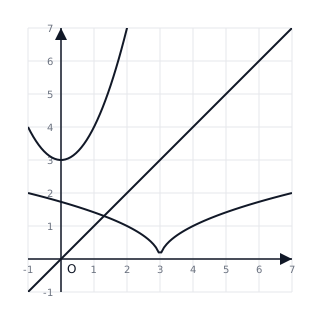
Consider the function for . Find the inverse function and state its domain.
Solution:
- Write the function as :
- Swap and :
- Solve for : Square both sides: So, .
- Determine the domain: The range of is . Therefore, the domain of is .
Explanation:
To find the inverse, we isolate the variable that was originally the input. Because the original function's output is always non-negative (square root), the inverse function is only defined for .