
Review the key concepts, formulae, and examples before starting your quiz.
🔑Concepts
The Domain of a function is the complete set of possible values for the independent variable (), which make the function 'work' and will output real -values. Graphically, it is the 'width' of the function along the -axis.
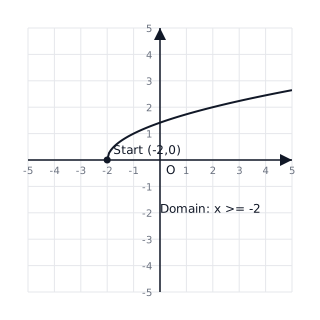
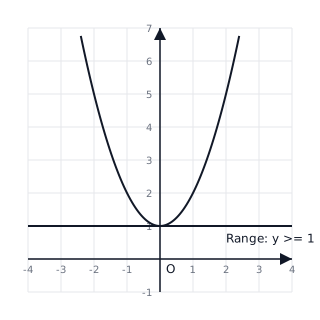
The Range of a function is the complete set of all possible resulting values of the dependent variable (), after we have substituted the domain. Graphically, it is the 'height' or vertical spread of the function.
For rational functions , the domain excludes any values where the denominator . These exclusions often appear as vertical asymptotes on a graph.
For square root functions , the domain is restricted to values where the radicand is non-negative: . This ensures the output remains within the set of real numbers.
📐Formulae
💡Examples
Problem 1:
Determine the domain of the function .
Solution:
Domain:
Explanation:
Since division by zero is undefined, the denominator cannot be equal to . Solving for gives the restriction.
Problem 2:
Find the range of the function for the domain .
Solution:
Range: or
Explanation:
The smallest value of is (when ). Therefore, the smallest value the function can take is . The graph opens upwards, so all values above are included.
Problem 3:
A ball is thrown in the air and its height in meters after seconds is given by . If the ball hits the ground at seconds, find the practical domain and range.
Solution:
Domain: To find the maximum height (Range), find the vertex: Range:
Explanation:
In a real-world context, time cannot be negative and stops when the ball hits the ground (). The range starts from the ground () up to the maximum height (the -coordinate of the vertex).
Problem 4:
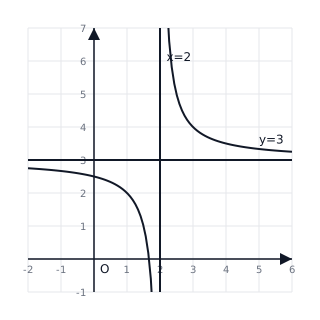
Identify the domain and range of the function based on its graph and algebraic properties.
Solution:
- Domain: The denominator cannot be zero. . Thus, Domain is .
- Range: As or , the fraction , so . The function never actually reaches the value . Thus, Range is .
Explanation:
The graph of a reciprocal function has vertical and horizontal asymptotes. The vertical asymptote at defines the exclusion in the domain, and the horizontal asymptote at defines the exclusion in the range.
Problem 5:
A restricted function is defined as for the domain . Find the range of this function.
![Graph of y = 4 - x^2 restricted to the domain [-1, 2].](https://s3.ap-south-1.amazonaws.com/prod-kritclub/science-diagrams/0f7d3356a92816abd1f98c3434d35fcf5e6d78463879b3c3d2e3e9e747665e8b.svg)
Solution:
- Evaluate the function at the boundaries and vertex:
- At , .
- At (the vertex), .
- At , .
- Identify the minimum and maximum -values: The highest point is at the vertex () and the lowest point within the interval is at ().
- Range is .
Explanation:
Since the vertex lies within the domain , the maximum value of the range is the -coordinate of the vertex. The minimum value is the lower of the two endpoint values.