
Review the key concepts, formulae, and examples before starting your quiz.
🔑Concepts
The general form of a quadratic function is . The graph is a parabola that opens upwards if and downwards if . The -intercept is always at .
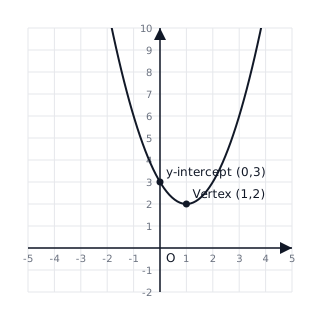
The vertex form directly gives the vertex at . The vertical line is the axis of symmetry, which divides the parabola into two congruent halves.
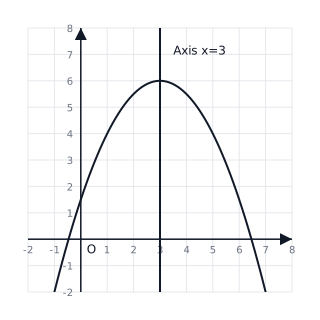
The factored form reveals the -intercepts at and . These are the roots or zeros of the quadratic equation .
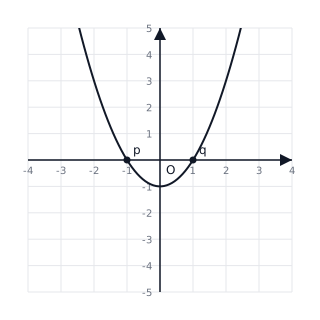
The Discriminant determines the number of -intercepts: if , there are two real intercepts; if , there is one (the vertex touches the axis); if , there are no real intercepts.
📐Formulae
💡Examples
Problem 1:
Given the quadratic function , find the coordinates of the vertex and the -intercepts.
Solution:
- Find the -coordinate of the vertex: .
- Find the -coordinate: . Vertex is .
- Find -intercepts by setting : .
Explanation:
The axis of symmetry formula provides the -coordinate of the vertex. Substituting this back into the function gives the minimum value. Factoring the quadratic allows us to identify where the graph crosses the -axis.
Problem 2:
A ball is thrown into the air. Its height, , in meters after seconds is modeled by . Determine the maximum height reached by the ball.
Solution:
The maximum height occurs at the vertex since .
- Find at the vertex: seconds.
- Calculate : meters.
Explanation:
In projectile motion, the vertex of the quadratic equation represents the peak of the trajectory. We find the time at which the maximum occurs and substitute it into the height function.
Problem 3:
Find the value of for which the equation has exactly one real solution.
Solution:
For exactly one real solution, the discriminant must be zero: . Using , , and : .
Explanation:
The discriminant determines the number of solutions. Setting it to zero ensures the parabola touches the -axis at exactly one point (the vertex).
Problem 4:
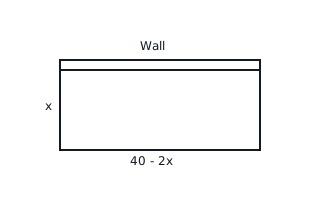
A rectangular garden is enclosed by meters of fencing. One side of the garden is against a straight brick wall and does not require fencing. Let be the length of the two sides perpendicular to the wall. Express the area in terms of and find the maximum possible area.
Solution:
Let the length perpendicular to the wall be . Since there are two such sides, the remaining length for the side parallel to the wall is . The area . This is a downward opening parabola. The maximum area occurs at the vertex. m. Maximum Area m.
Explanation:
We model the area as a quadratic function of . Finding the maximum area corresponds to finding the -coordinate of the vertex of the parabola.
Problem 5:
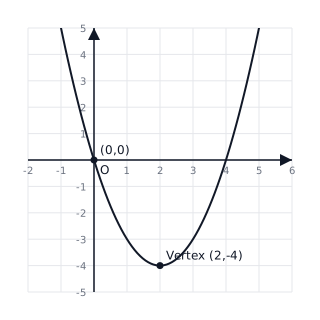
Determine the equation of the quadratic function shown in the graph, which has a vertex at and passes through the point .
Solution:
Use the vertex form . Substitute the vertex : . To find , substitute the point : . The equation is , or .
Explanation:
Vertex form is the most efficient starting point when the coordinates of the turning point are known. Solving for 'a' ensures the parabola passes through the secondary given point.