
Review the key concepts, formulae, and examples before starting your quiz.
🔑Concepts
A piecewise function is a function defined by multiple sub-functions, each applying to a specific interval of the main function's domain. The general form is .
The domain of the entire piecewise function is the union of all the individual sub-domains. It is critical to check whether endpoints are included (using or ) or excluded (using or ).
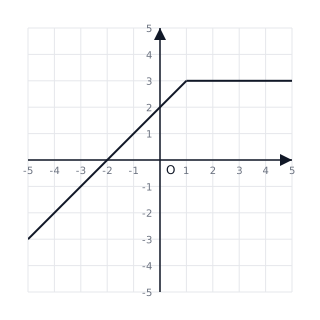
A piecewise function is continuous at a boundary point if the values of the functions from the left and right approach the same value, and that value equals the function's value at . Visually, the graph has no 'jumps' or 'holes'.
Real-world applications often involve step functions (like postage costs) or graduated rates (like income tax or utility billing), where the rate of change shifts at specific thresholds.
📐Formulae
💡Examples
Problem 1:
Given the function , evaluate and .
Solution:
- To find , observe that . Thus, we use the first rule:
- To find , observe that . Thus, we use the second rule:
Explanation:
We identify which domain interval the input falls into and substitute the value into the corresponding expression.
Problem 2:
A car rental company charges a flat fee of Rs 40 for the first driven. For every kilometer driven beyond , they charge an additional Rs 0.50 per kilometer. Write a piecewise function for the total cost where is the distance in kilometers.
Solution:
For , the cost is constant: . For , the cost is the initial Rs 40 plus Rs 0.50 for the distance exceeding , which is .
Explanation:
This is a common modeling problem where the rate changes after a threshold. The second part of the function calculates the 'extra' distance by subtracting the threshold from the total distance.
Problem 3:
Find the value of that makes the function continuous at :
Solution:
For the function to be continuous at , the two pieces must meet at the same -value. Set the expressions equal to each other at :
Explanation:
Continuity ensures there is no 'jump' in the graph. We substitute the boundary value into both expressions and solve for the unknown parameter.
Problem 4:
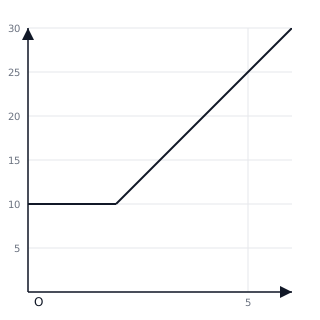
A mobile data plan costs USD for the first GB of data. For every GB exceeding GB, the cost is USD per GB. Express the total cost as a function of data used (in GB) and find the cost for using GB.
Solution:
The function is defined in two parts:
- For , the cost is constant: .
- For , the cost is the base plus for every unit over : .
So, .
For : USD.
Explanation:
Identify the threshold ( GB). Below this, the rate is zero (constant cost). Above this, the rate is per unit. We use the second part of the function because .
Problem 5:
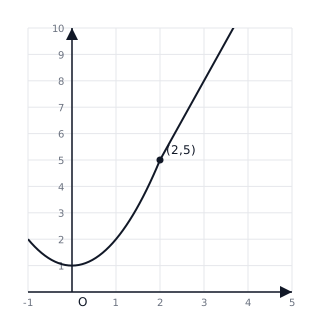
Determine the value of such that is continuous at :
Solution:
For continuity at , the limit from the left must equal the limit from the right:
Left side: Right side:
Set them equal:
Explanation:
We equate the expressions for the two pieces at the boundary to ensure they meet at the same y-coordinate, eliminating any jump.