krit.club logo

Introduction to Trigonometry - Use relationships among trigonometric ratios to simplify and solve expressions

Grade 10CBSE

Review the key concepts, formulae, and examples before starting your quiz.

🔑Concepts

•

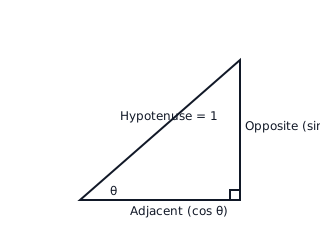
The fundamental trigonometric identity sin⁡2θ+cos⁡2θ=1\sin^2 \theta + \cos^2 \theta = 1 is derived from the Pythagorean theorem applied to a right-angled triangle. By dividing this equation by cos⁡2θ\cos^2 \theta or sin⁡2θ\sin^2 \theta, we obtain the other two identities: 1+tan⁡2θ=sec⁡2θ1 + \tan^2 \theta = \sec^2 \theta and 1+cot⁡2θ=csc⁡2θ1 + \cot^2 \theta = \csc^2 \theta.

Right-angled triangle on a unit circle illustrating trigonometric ratios as sides.
•

Reciprocal and Quotient Relationships: When simplifying complex expressions, it is often helpful to convert all terms into sin⁡θ\sin \theta and cos⁡θ\cos \theta. Key substitutions include tan⁡θ=sin⁡θcos⁡θ\tan \theta = \frac{\sin \theta}{\cos \theta}, cot⁡θ=cos⁡θsin⁡θ\cot \theta = \frac{\cos \theta}{\sin \theta}, sec⁡θ=1cos⁡θ\sec \theta = \frac{1}{\cos \theta}, and csc⁡θ=1sin⁡θ\csc \theta = \frac{1}{\sin \theta}.

•

Algebraic Manipulation: Use standard algebraic identities like (a+b)(a−b)=a2−b2(a+b)(a-b) = a^2 - b^2 and (a±b)2=a2±2ab+b2(a \pm b)^2 = a^2 \pm 2ab + b^2 in conjunction with trigonometric identities to factorize or expand expressions before simplifying.

•

Rationalization Technique: For expressions involving denominators like (1±sin⁡θ)(1 \pm \sin \theta) or (1±cos⁡θ)(1 \pm \cos \theta), multiplying the numerator and denominator by the conjugate (e.g., 1∓sin⁡θ1 \mp \sin \theta) frequently creates a squared term that can be simplified using cos⁡2θ=1−sin⁡2θ\cos^2 \theta = 1 - \sin^2 \theta.

📐Formulae

sin⁡2θ+cos⁡2θ=1\sin^2 \theta + \cos^2 \theta = 1

1+tan⁡2θ=sec⁡2θ1 + \tan^2 \theta = \sec^2 \theta

1+cot⁡2θ=csc⁡2θ1 + \cot^2 \theta = \csc^2 \theta

tan⁡θ=sin⁡θcos⁡θ\tan \theta = \frac{\sin \theta}{\cos \theta}

csc⁡θ=1sin⁡θ\csc \theta = \frac{1}{\sin \theta}

sec⁡θ=1cos⁡θ\sec \theta = \frac{1}{\cos \theta}

cot⁡θ=1tan⁡θ=cos⁡θsin⁡θ\cot \theta = \frac{1}{\tan \theta} = \frac{\cos \theta}{\sin \theta}

💡Examples

Problem 1:

Simplify the expression: (sec⁡A+tan⁡A)(1−sin⁡A)(\sec A + \tan A)(1 - \sin A).

Solution:

Step 1: Convert sec⁡A\sec A and tan⁡A\tan A into terms of sin⁡A\sin A and cos⁡A\cos A. (1cos⁡A+sin⁡Acos⁡A)(1−sin⁡A)(\frac{1}{\cos A} + \frac{\sin A}{\cos A})(1 - \sin A)

Step 2: Combine the terms in the first bracket. (1+sin⁡Acos⁡A)(1−sin⁡A)(\frac{1 + \sin A}{\cos A})(1 - \sin A)

Step 3: Multiply the numerators. (1+sin⁡A)(1−sin⁡A)cos⁡A=1−sin⁡2Acos⁡A\frac{(1 + \sin A)(1 - \sin A)}{\cos A} = \frac{1 - \sin^2 A}{\cos A}

Step 4: Use the identity sin⁡2A+cos⁡2A=1  ⟹  1−sin⁡2A=cos⁡2A\sin^2 A + \cos^2 A = 1 \implies 1 - \sin^2 A = \cos^2 A. cos⁡2Acos⁡A=cos⁡A\frac{\cos^2 A}{\cos A} = \cos A

Explanation:

By converting the expression to sine and cosine, we use the algebraic identity (a+b)(a−b)=a2−b2(a+b)(a-b) = a^2 - b^2 and the Pythagorean identity to simplify to a single ratio.

Problem 2:

Prove that: cos⁡A1+sin⁡A+1+sin⁡Acos⁡A=2sec⁡A\frac{\cos A}{1 + \sin A} + \frac{1 + \sin A}{\cos A} = 2 \sec A.

Solution:

Taking LHS: cos⁡2A+(1+sin⁡A)2cos⁡A(1+sin⁡A)\frac{\cos^2 A + (1 + \sin A)^2}{\cos A (1 + \sin A)} Expanding (1+sin⁡A)2(1 + \sin A)^2: cos⁡2A+1+sin⁡2A+2sin⁡Acos⁡A(1+sin⁡A)\frac{\cos^2 A + 1 + \sin^2 A + 2\sin A}{\cos A (1 + \sin A)} Since sin⁡2A+cos⁡2A=1\sin^2 A + \cos^2 A = 1: 1+1+2sin⁡Acos⁡A(1+sin⁡A)=2+2sin⁡Acos⁡A(1+sin⁡A)\frac{1 + 1 + 2\sin A}{\cos A (1 + \sin A)} = \frac{2 + 2\sin A}{\cos A (1 + \sin A)} Factoring out 2 in the numerator: 2(1+sin⁡A)cos⁡A(1+sin⁡A)=2cos⁡A=2sec⁡A=RHS\frac{2(1 + \sin A)}{\cos A (1 + \sin A)} = \frac{2}{\cos A} = 2 \sec A = RHS

Explanation:

We find a common denominator, expand the algebraic expression, and apply the identity sin⁡2A+cos⁡2A=1\sin^2 A + \cos^2 A = 1 to simplify the numerator and cancel common terms.

Problem 3:

Prove that (sin⁡θ+csc⁡θ)2+(cos⁡θ+sec⁡θ)2=7+tan⁡2θ+cot⁡2θ(\sin \theta + \csc \theta)^2 + (\cos \theta + \sec \theta)^2 = 7 + \tan^2 \theta + \cot^2 \theta.

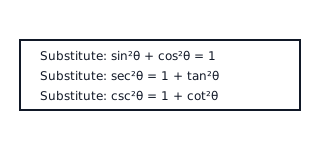
Conceptual mapping of trigonometric identity substitutions.

Solution:

LHS =(sin⁡θ+csc⁡θ)2+(cos⁡θ+sec⁡θ)2= (\sin \theta + \csc \theta)^2 + (\cos \theta + \sec \theta)^2 Expanding the squares: =(sin⁡2θ+csc⁡2θ+2sin⁡θcsc⁡θ)+(cos⁡2θ+sec⁡2θ+2cos⁡θsec⁡sec⁡θ)= (\sin^2 \theta + \csc^2 \theta + 2\sin \theta \csc \theta) + (\cos^2 \theta + \sec^2 \theta + 2\cos \theta \sec \sec \theta) Since sin⁡θcsc⁡θ=1\sin \theta \csc \theta = 1 and cos⁡θsec⁡θ=1\cos \theta \sec \theta = 1: =sin⁡2θ+csc⁡2θ+2+cos⁡2θ+sec⁡2θ+2= \sin^2 \theta + \csc^2 \theta + 2 + \cos^2 \theta + \sec^2 \theta + 2 =(sin⁡2θ+cos⁡2θ)+4+csc⁡2θ+sec⁡2θ= (\sin^2 \theta + \cos^2 \theta) + 4 + \csc^2 \theta + \sec^2 \theta Using identities sin⁡2θ+cos⁡2θ=1\sin^2 \theta + \cos^2 \theta = 1, csc⁡2θ=1+cot⁡2θ\csc^2 \theta = 1 + \cot^2 \theta, and sec⁡2θ=1+tan⁡2θ\sec^2 \theta = 1 + \tan^2 \theta: =1+4+(1+cot⁡2θ)+(1+tan⁡2θ)= 1 + 4 + (1 + \cot^2 \theta) + (1 + \tan^2 \theta) =7+tan⁡2θ+cot⁡2θ= 7 + \tan^2 \theta + \cot^2 \theta LHS = RHS.

Explanation:

The expression was expanded using (a+b)2(a+b)^2. Reciprocal pairs like sin⁡θ\sin \theta and csc⁡θ\csc \theta cancel out to constants. Finally, Pythagorean identities convert csc⁡\csc and sec⁡\sec into cot⁡\cot and tan⁡\tan.

Problem 4:

Simplify the expression: 1+sin⁡A1−sin⁡A\sqrt{\frac{1 + \sin A}{1 - \sin A}}.

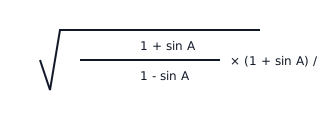
Visual representation of the rationalization step for trigonometric fractions.

Solution:

Multiply numerator and denominator inside the square root by the conjugate of the denominator, (1+sin⁡A)(1 + \sin A): =(1+sin⁡A)(1+sin⁡A)(1−sin⁡A)(1+sin⁡A)= \sqrt{\frac{(1 + \sin A)(1 + \sin A)}{(1 - \sin A)(1 + \sin A)}} =(1+sin⁡A)21−sin⁡2A= \sqrt{\frac{(1 + \sin A)^2}{1 - \sin^2 A}} Using the identity 1−sin⁡2A=cos⁡2A1 - \sin^2 A = \cos^2 A: =(1+sin⁡A)2cos⁡2A= \sqrt{\frac{(1 + \sin A)^2}{\cos^2 A}} =1+sin⁡Acos⁡A= \frac{1 + \sin A}{\cos A} =1cos⁡A+sin⁡Acos⁡A= \frac{1}{\cos A} + \frac{\sin A}{\cos A} =sec⁡A+tan⁡A= \sec A + \tan A

Explanation:

Rationalizing the denominator under the square root transforms the denominator into a single squared term using the identity 1−sin⁡2A=cos⁡2A1 - \sin^2 A = \cos^2 A, allowing the square root to be removed.