
Review the key concepts, formulae, and examples before starting your quiz.
🔑Concepts
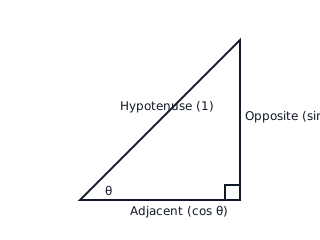
Trigonometric identities are equations involving trigonometric ratios of an angle that are true for all values of the angle for which the ratios are defined. The fundamental identity is derived from the Pythagorean theorem applied to a right-angled triangle where . Dividing this equation by different side lengths leads to the three main identities.
The identity is valid for all . It links the secant and tangent functions. It can be rearranged as or .
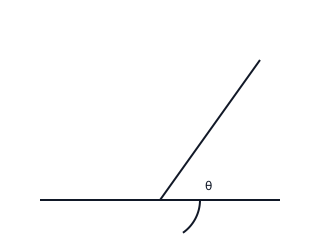
The identity is valid for all . This identity is crucial for simplifying expressions involving reciprocal ratios like cosecant and cotangent.

A common strategy for proving complex identities is to convert all trigonometric ratios (sec, cosec, tan, cot) into sine and cosine terms first, then simplify using algebraic identities like or .

📐Formulae
💡Examples
Problem 1:
Prove the following identity:
Solution:
Taking the LCM: Expanding the numerator: Since : Factorizing the numerator:
Explanation:
To solve this, we find a common denominator (LCM), expand the squared term using , apply the identity , and then simplify the fraction by canceling common factors.
Problem 2:
Express the ratio in terms of .
Solution:
We know that: Rearranging for : Since , we substitute: Taking the LCM on the right side: Taking the square root of both sides:
Explanation:
Using the Pythagorean identity and the reciprocal relationship between and , we can express one trigonometric ratio purely in terms of another.
Problem 3:
Calculate the value of .
Solution:
The expression is: Factorizing out : Using the identity , which implies :
Explanation:
This problem uses a direct application of the secondary trigonometric identity after factoring out the common coefficient.
Problem 4:
Prove the following identity:
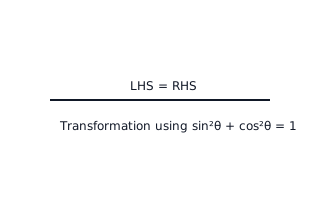
Solution:
LHS: Using : Using : Hence Proved.
Explanation:
Convert the terms into sine and cosine, common denominator, and use the Pythagorean identity to transform the denominator.
Problem 5:
Prove that:
Solution:
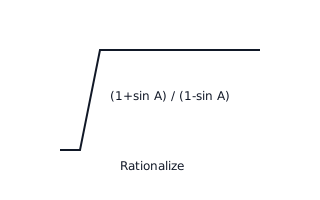
LHS: Multiply numerator and denominator by (Rationalizing): Since : Hence Proved.
Explanation:
Rationalize the denominator inside the square root by multiplying with the conjugate of the denominator, then apply the identity .