krit.club logo

Introduction to Trigonometry - Define trigonometric ratios for acute angles in right triangles and justify well-definedness

Grade 10CBSE

Review the key concepts, formulae, and examples before starting your quiz.

🔑Concepts

•

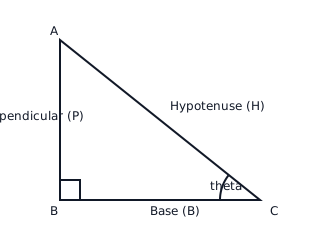
Trigonometry involves the study of relationships between the sides and angles of a triangle. In a right-angled triangle, the side opposite to the right angle is called the hypotenuse (HH). For an acute angle θ\theta, the side opposite to it is the 'Perpendicular' (PP) and the side adjacent to it is the 'Base' (BB).

Right-angled triangle ABC with angle theta at C, identifying Perpendicular, Base, and Hypotenuse.
•

The trigonometric ratios are defined based on the side lengths: sin⁡θ=PH\sin \theta = \frac{P}{H}, cos⁡θ=BH\cos \theta = \frac{B}{H}, tan⁡θ=PB\tan \theta = \frac{P}{B}, cosec θ=HP\text{cosec } \theta = \frac{H}{P}, sec⁡θ=HB\sec \theta = \frac{H}{B}, and cot⁡θ=BP\cot \theta = \frac{B}{P}.

Mnemonic for trigonometric ratios.
•

Well-definedness: The trigonometric ratios of an angle do not vary with the lengths of the sides of the triangle, if the angle remains the same. This is because all right-angled triangles with the same acute angle θ\theta are similar by AA similarity criterion. Thus, the ratio of corresponding sides remains constant.
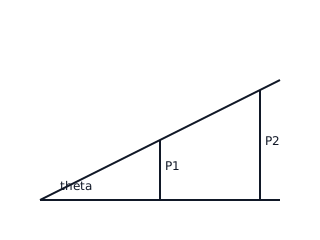
Similar triangles showing constant ratios for the same angle theta.
•

Reciprocal relationships: cosec θ\text{cosec } \theta is the reciprocal of sin⁡θ\sin \theta, sec⁡θ\sec \theta is the reciprocal of cos⁡θ\cos \theta, and cot⁡θ\cot \theta is the reciprocal of tan⁡θ\tan \theta.

📐Formulae

sin⁡θ=Perpendicular (P)Hypotenuse (H)\sin \theta = \frac{\text{Perpendicular (P)}}{\text{Hypotenuse (H)}}

cos⁡θ=Base (B)Hypotenuse (H)\cos \theta = \frac{\text{Base (B)}}{\text{Hypotenuse (H)}}

tan⁡θ=Perpendicular (P)Base (B)\tan \theta = \frac{\text{Perpendicular (P)}}{\text{Base (B)}}

cosec θ=1sin⁡θ=HP\text{cosec } \theta = \frac{1}{\sin \theta} = \frac{H}{P}

sec⁡θ=1cos⁡θ=HB\sec \theta = \frac{1}{\cos \theta} = \frac{H}{B}

cot⁡θ=1tan⁡θ=BP\cot \theta = \frac{1}{\tan \theta} = \frac{B}{P}

sin⁡2θ+cos⁡2θ=1\sin^2 \theta + \cos^2 \theta = 1

1+tan⁡2θ=sec⁡2θ1 + \tan^2 \theta = \sec^2 \theta

1+cot⁡2θ=cosec2θ1 + \cot^2 \theta = \text{cosec}^2 \theta

💡Examples

Problem 1:

In △ABC\triangle ABC, right-angled at BB, if sin⁡A=35\sin A = \frac{3}{5}, find the value of cos⁡A\cos A and tan⁡A\tan A.

Solution:

  1. Given sin⁡A=PH=35\sin A = \frac{P}{H} = \frac{3}{5}. Let P=3kP = 3k and H=5kH = 5k for some constant kk.
  2. Use Pythagoras Theorem: H2=P2+B2H^2 = P^2 + B^2.
  3. (5k)2=(3k)2+B2⇒25k2=9k2+B2(5k)^2 = (3k)^2 + B^2 \Rightarrow 25k^2 = 9k^2 + B^2.
  4. B2=25k2−9k2=16k2⇒B=16k2=4kB^2 = 25k^2 - 9k^2 = 16k^2 \Rightarrow B = \sqrt{16k^2} = 4k.
  5. cos⁡A=BH=4k5k=45\cos A = \frac{B}{H} = \frac{4k}{5k} = \frac{4}{5}.
  6. tan⁡A=PB=3k4k=34\tan A = \frac{P}{B} = \frac{3k}{4k} = \frac{3}{4}.

Explanation:

We use the definition of the sine ratio to identify two sides of the triangle, apply the Pythagoras theorem to find the third side (Base), and then use the definitions of cosine and tangent to find their respective values.

Problem 2:

Evaluate the expression: sin⁡60∘cos⁡30∘+sin⁡30∘cos⁡60∘\sin 60^\circ \cos 30^\circ + \sin 30^\circ \cos 60^\circ.

Solution:

  1. Substitute the standard values: sin⁡60∘=32\sin 60^\circ = \frac{\sqrt{3}}{2} cos⁡30∘=32\cos 30^\circ = \frac{\sqrt{3}}{2} sin⁡30∘=12\sin 30^\circ = \frac{1}{2} cos⁡60∘=12\cos 60^\circ = \frac{1}{2}
  2. The expression becomes: (32)(32)+(12)(12)(\frac{\sqrt{3}}{2})(\frac{\sqrt{3}}{2}) + (\frac{1}{2})(\frac{1}{2})
  3. Multiply the terms: 34+14\frac{3}{4} + \frac{1}{4}
  4. Add the fractions: 3+14=44=1\frac{3+1}{4} = \frac{4}{4} = 1.

Explanation:

This problem requires substituting known values of trigonometric ratios for standard angles and performing basic algebraic simplification.

Problem 3:

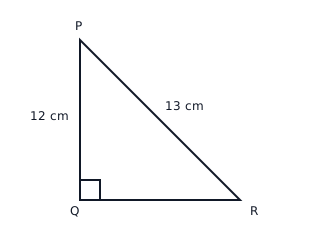
In △PQR\triangle PQR, right-angled at QQ, PQ=12 cmPQ = 12 \text{ cm} and PR=13 cmPR = 13 \text{ cm}. Determine the value of tan⁡P−cot⁡R\tan P - \cot R.

Triangle PQR with PQ=12 and PR=13.

Solution:

  1. Find QRQR using Pythagoras theorem: QR=PR2−PQ2=132−122=169−144=25=5 cmQR = \sqrt{PR^2 - PQ^2} = \sqrt{13^2 - 12^2} = \sqrt{169 - 144} = \sqrt{25} = 5 \text{ cm}
  2. For ∠P\angle P, side opposite is QR=5QR=5 (Perpendicular) and adjacent is PQ=12PQ=12 (Base). tan⁡P=QRPQ=512\tan P = \frac{QR}{PQ} = \frac{5}{12}
  3. For ∠R\angle R, side opposite is PQ=12PQ=12 (Perpendicular) and adjacent is QR=5QR=5 (Base). cot⁡R=BasePerpendicular=QRPQ=512\cot R = \frac{\text{Base}}{\text{Perpendicular}} = \frac{QR}{PQ} = \frac{5}{12}
  4. Calculate the difference: tan⁡P−cot⁡R=512−512=0\tan P - \cot R = \frac{5}{12} - \frac{5}{12} = 0

Explanation:

The problem tests the ability to identify Perpendicular and Base relative to the specific acute angle being considered and applies the Pythagoras theorem.

Problem 4:

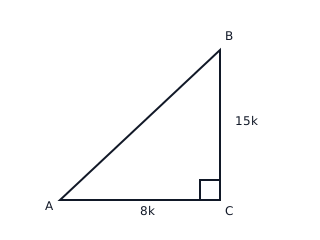
Given 15cot⁡A=815 \cot A = 8, find sin⁡A\sin A and sec⁡A\sec A.

Triangle ABC for angle A with base 8k and perpendicular 15k.

Solution:

  1. Rearrange the given equation: cot⁡A=815\cot A = \frac{8}{15}
  2. Since cot⁡A=BP\cot A = \frac{B}{P}, let B=8kB = 8k and P=15kP = 15k.
  3. Find Hypotenuse (HH) using Pythagoras theorem: H=(15k)2+(8k)2=225k2+64k2=289k2=17kH = \sqrt{(15k)^2 + (8k)^2} = \sqrt{225k^2 + 64k^2} = \sqrt{289k^2} = 17k
  4. Calculate ratios: sin⁡A=PH=15k17k=1517\sin A = \frac{P}{H} = \frac{15k}{17k} = \frac{15}{17} sec⁡A=HB=17k8k=178\sec A = \frac{H}{B} = \frac{17k}{8k} = \frac{17}{8}

Explanation:

This example shows how to find all trigonometric ratios when one ratio is given by using the Pythagorean relationship between sides.

Define trigonometric ratios for acute angles in right triangles and justify well-definedness Class…