
Introduction to Trigonometry - Evaluate trigonometric ratios at standard angles 0 degree, 30 degree, 45 degree, 60 degree, and 90 degree
Review the key concepts, formulae, and examples before starting your quiz.
🔑Concepts
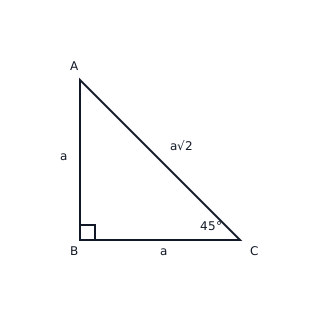
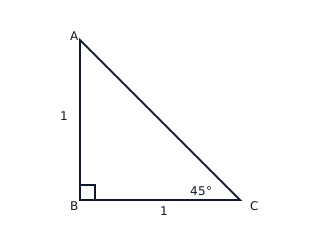
The trigonometric ratios of are derived using an isosceles right-angled triangle where the two legs are equal. If each leg is , the hypotenuse is by Pythagoras theorem. Thus, and .
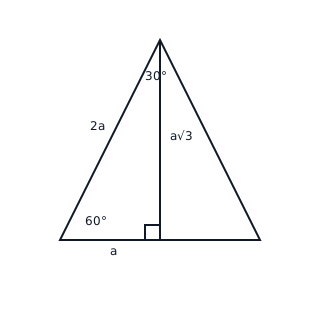
For angles and , we use an equilateral triangle with side . Dropping a perpendicular from one vertex bisects the base and creates a triangle with sides , , and .
As increases from to , increases from to , while decreases from to . The value of increases from to infinity (undefined at ).
Reciprocal relationships are essential for evaluation: is the inverse of , is the inverse of , and is the inverse of .
📐Formulae
💡Examples
Problem 1:
Evaluate:
Solution:
Step 1: Substitute the values of trigonometric ratios.
Step 2: Place them into the expression:
Step 3: Simplify the terms:
Step 4: Add the fractions:
Explanation:
This problem uses the standard values of trigonometric ratios for and . It also demonstrates the identity where and .
Problem 2:
In , right-angled at , cm and . Determine the length of the side .
Solution:
Step 1: Identify the given information and the required side. Given: Perpendicular () = cm, . To find: Base ().
Step 2: Choose the trigonometric ratio that relates Perpendicular and Base.
Step 3: Substitute the known values.
Step 4: Solve for . cm
Explanation:
To find a missing side when an angle and one side are given, identify which trigonometric ratio (sin, cos, or tan) connects the given side and the side to be found. Here, tangent is used because we are dealing with the opposite (perpendicular) and adjacent (base) sides.
Problem 3:
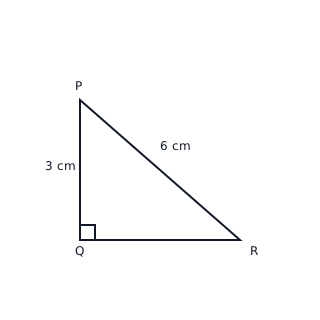
In a right triangle , right-angled at , cm and cm. Find and .
Solution:
- To find (let it be ):
- Since , we have .
- To find : We know .
Explanation:
We use the definition of the sine ratio for the known sides to identify the standard angle. Then, the angle sum property of a triangle is used to find the third angle.
Problem 4:
Evaluate the following expression:
Solution:
We know the values of the trigonometric ratios at standard angles:
Substituting these values into the expression:
Calculating the squares:
Simplifying the terms:
Explanation:
To solve this problem, we identify the values of the specific trigonometric functions at the given angles. Notice that and are equal (), so their squares cancel each other out, leaving only the term containing .