krit.club logo

Introduction to Trigonometry - Introduction

Grade 10CBSE

Review the key concepts, formulae, and examples before starting your quiz.

🔑Concepts

•

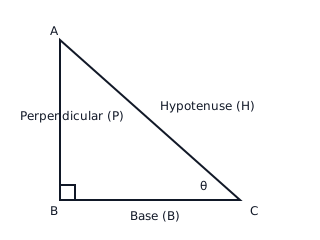
The fundamental concept of trigonometry involves the study of relationships between the sides and angles of a right-angled triangle. In a right-angled triangle, the side opposite the reference angle θ\theta is called the Perpendicular (PP), the side adjacent to it is the Base (BB), and the longest side opposite the 90∘90^{\circ} angle is the Hypotenuse (HH).

Right-angled triangle ABC showing sides relative to angle theta
•

The values of trigonometric ratios for a specific angle do not depend on the size of the triangle (lengths of sides) as long as the angle remains the same. If we draw a line parallel to one side of the triangle, the ratios for the corresponding angles in the smaller and larger triangles will be equal due to similarity.
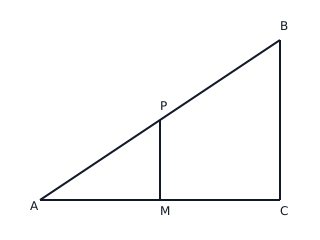
Similar right triangles showing consistent ratios for the same angle
•

The reciprocal relationships link the primary ratios (sine, cosine, tangent) to their counterparts: cosec θ\text{cosec } \theta is the reciprocal of sin⁡θ\sin \theta, sec⁡θ\sec \theta is the reciprocal of cos⁡θ\cos \theta, and cot⁡θ\cot \theta is the reciprocal of tan⁡θ\tan \theta.

•

The Quotient Rule states that tan⁡θ=sin⁡θcos⁡θ\tan \theta = \frac{\sin \theta}{\cos \theta} and cot⁡θ=cos⁡θsin⁡θ\cot \theta = \frac{\cos \theta}{\sin \theta}. These identities allow us to find any ratio if sine and cosine are known.

📐Formulae

sin⁡A=Side opposite to ∠AHypotenuse=PH\sin A = \frac{\text{Side opposite to } \angle A}{\text{Hypotenuse}} = \frac{P}{H}

cos⁡A=Side adjacent to ∠AHypotenuse=BH\cos A = \frac{\text{Side adjacent to } \angle A}{\text{Hypotenuse}} = \frac{B}{H}

tan⁡A=Side opposite to ∠ASide adjacent to ∠A=PB\tan A = \frac{\text{Side opposite to } \angle A}{\text{Side adjacent to } \angle A} = \frac{P}{B}

cosec A=1sin⁡A=HP\text{cosec } A = \frac{1}{\sin A} = \frac{H}{P}

sec⁡A=1cos⁡A=HB\sec A = \frac{1}{\cos A} = \frac{H}{B}

cot⁡A=1tan⁡A=BP\cot A = \frac{1}{\tan A} = \frac{B}{P}

tan⁡A=sin⁡Acos⁡A\tan A = \frac{\sin A}{\cos A}

cot⁡A=cos⁡Asin⁡A\cot A = \frac{\cos A}{\sin A}

💡Examples

Problem 1:

In △ABC\triangle ABC, right-angled at BB, AB=24AB = 24 cm, BC=7BC = 7 cm. Determine sin⁡A\sin A and cos⁡A\cos A.

Solution:

First, we find the hypotenuse ACAC using Pythagoras Theorem: AC2=AB2+BC2AC^2 = AB^2 + BC^2 AC2=242+72AC^2 = 24^2 + 7^2 AC2=576+49=625AC^2 = 576 + 49 = 625 AC=625=25 cmAC = \sqrt{625} = 25\text{ cm}

For ∠A\angle A: Side opposite (PP) = BC=7BC = 7 cm Side adjacent (BB) = AB=24AB = 24 cm Hypotenuse (HH) = AC=25AC = 25 cm

sin⁡A=PH=725\sin A = \frac{P}{H} = \frac{7}{25} cos⁡A=BH=2425\cos A = \frac{B}{H} = \frac{24}{25}

Explanation:

We first calculate the missing side using the Pythagorean theorem and then apply the standard definitions of sine (Opposite/Hypotenuse) and cosine (Adjacent/Hypotenuse) relative to angle AA.

Problem 2:

Given sec⁡θ=1312\sec \theta = \frac{13}{12}, calculate all other trigonometric ratios.

Solution:

We know sec⁡θ=HB=1312\sec \theta = \frac{H}{B} = \frac{13}{12}. Let H=13kH = 13k and B=12kB = 12k. Using H2=P2+B2H^2 = P^2 + B^2: (13k)2=P2+(12k)2(13k)^2 = P^2 + (12k)^2 169k2=P2+144k2169k^2 = P^2 + 144k^2 P2=169k2−144k2=25k2P^2 = 169k^2 - 144k^2 = 25k^2 P=25k2=5kP = \sqrt{25k^2} = 5k

Now find the ratios: sin⁡θ=PH=5k13k=513\sin \theta = \frac{P}{H} = \frac{5k}{13k} = \frac{5}{13} cos⁡θ=BH=12k13k=1213\cos \theta = \frac{B}{H} = \frac{12k}{13k} = \frac{12}{13} tan⁡θ=PB=5k12k=512\tan \theta = \frac{P}{B} = \frac{5k}{12k} = \frac{5}{12} cosec θ=1sin⁡θ=135\text{cosec } \theta = \frac{1}{\sin \theta} = \frac{13}{5} cot⁡θ=1tan⁡θ=125\cot \theta = \frac{1}{\tan \theta} = \frac{12}{5}

Explanation:

By representing the ratio as sides of a triangle using a constant kk, we use Pythagoras theorem to find the third side (Perpendicular) and then calculate the remaining five trigonometric ratios.

Problem 3:

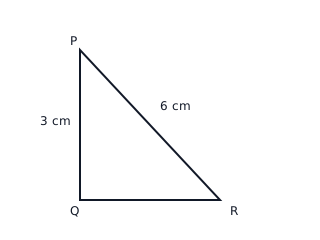
In △PQR\triangle PQR, right-angled at QQ, PQ=3PQ = 3 cm and PR=6PR = 6 cm. Determine the values of sin⁡R\sin R and cos⁡R\cos R.

Right triangle PQR with given side lengths

Solution:

  1. Identify sides: PQ=3PQ = 3 (Opposite to ∠R\angle R), PR=6PR = 6 (Hypotenuse).
  2. Calculate sin⁡R\sin R: sin⁡R=PQPR=36=12\sin R = \frac{PQ}{PR} = \frac{3}{6} = \frac{1}{2}
  3. Find QRQR using Pythagoras Theorem: PR2=PQ2+QR2PR^2 = PQ^2 + QR^2 62=32+QR26^2 = 3^2 + QR^2 36=9+QR236 = 9 + QR^2 QR2=27QR^2 = 27 QR=33QR = 3\sqrt{3}
  4. Calculate cos⁡R\cos R: cos⁡R=QRPR=336=32\cos R = \frac{QR}{PR} = \frac{3\sqrt{3}}{6} = \frac{\sqrt{3}}{2}

Explanation:

We use the definitions of sine as Opposite/Hypotenuse and cosine as Adjacent/Hypotenuse. Pythagoras theorem is used to find the unknown adjacent side.

Problem 4:

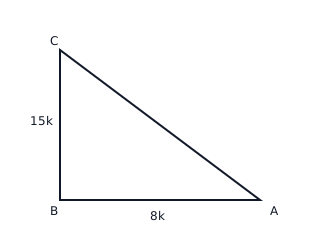
Given 15cot⁡A=815 \cot A = 8, find sin⁡A\sin A and sec⁡A\sec A.

Triangle representing cot A = 8/15

Solution:

  1. Express cot⁡A\cot A as a ratio: cot⁡A=815\cot A = \frac{8}{15}
  2. Since cot⁡A=BasePerpendicular\cot A = \frac{\text{Base}}{\text{Perpendicular}}, let B=8kB = 8k and P=15kP = 15k.
  3. Find Hypotenuse (HH) using Pythagoras Theorem: H2=P2+B2H^2 = P^2 + B^2 H2=(15k)2+(8k)2=225k2+64k2=289k2H^2 = (15k)^2 + (8k)^2 = 225k^2 + 64k^2 = 289k^2 H=17kH = 17k
  4. Calculate sin⁡A\sin A: sin⁡A=PH=15k17k=1517\sin A = \frac{P}{H} = \frac{15k}{17k} = \frac{15}{17}
  5. Calculate sec⁡A\sec A: sec⁡A=HB=17k8k=178\sec A = \frac{H}{B} = \frac{17k}{8k} = \frac{17}{8}

Explanation:

Cotangent is the ratio of Base to Perpendicular. We assume side lengths based on this ratio and find the hypotenuse to determine sine and secant.