
Review the key concepts, formulae, and examples before starting your quiz.
🔑Concepts
Ohm's Law states that the electric current () flowing through a metallic conductor is directly proportional to the potential difference () across its ends, provided its temperature remains the same ().
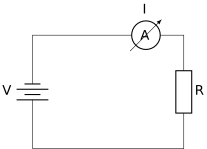
The ratio for a given metallic wire at a constant temperature is a constant called Resistance (). This is mathematically expressed as .
Resistance is the property of a conductor to resist the flow of charges through it. Its SI unit is the Ohm, represented by the Greek letter .
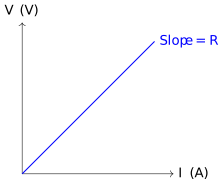
The graph for an ohmic conductor is a straight line passing through the origin. The slope of this line represents the Resistance of the conductor.
Factors affecting resistance include the length of the conductor (), the area of cross-section (), and the nature of the material.
📐Formulae
(where is Conductance)
💡Examples
Problem 1:
How much current will an electric bulb draw from a source, if the resistance of the bulb filament is ?
Solution:
Given: , . Using Ohm's Law:
Explanation:
We apply the direct relationship to find the current flowing through the filament.
Problem 2:
The potential difference between the terminals of an electric heater is when it draws a current of from the source. What current will the heater draw if the potential difference is increased to ?
Solution:
First, find the resistance: Now, use this resistance for the new potential difference :
Explanation:
Resistance remains constant for the same heater. Doubling the voltage results in doubling the current, as .
Problem 3:
A wire of length and cross-sectional area has a resistance of . What will be the resistance of another wire of the same material with length and area ?
Solution:
Initial resistance . For the new wire:
Explanation:
Since both the length and the area were doubled, the ratio remains unchanged, keeping the resistance the same.
Problem 4:
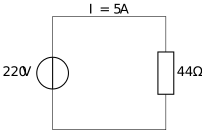
An electric iron has a resistance of . If it is connected to a supply, calculate the current passing through the iron. Represent the circuit used.
Solution:
Given: , . According to Ohm's Law: The current passing through the iron is .
Explanation:
We use the standard form of Ohm's Law where current is the quotient of potential difference and resistance. Since the units are already in Volts and Ohms, the result is in Amperes.
Problem 5:
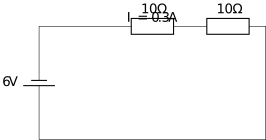
A resistance wire of is connected to a battery. Calculate the current flowing through the circuit. If another identical resistor is connected in series with the first one, what will be the new current in the circuit? Draw the circuit diagram for the second case.
Solution:
Case 1: Given and . Using Ohm's Law:
Case 2: Two resistors of are in series. Total Resistance, . New Current,
Explanation:
According to Ohm's Law, current is inversely proportional to resistance for a constant potential difference. When the resistance was doubled (from to ), the current was halved (from to ).