
Electricity - Calculate resistance, resistivity, and equivalent resistance in series and parallel circuits
Review the key concepts, formulae, and examples before starting your quiz.
🔑Concepts
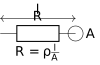
Resistance () is the property of a conductor to resist the flow of charges through it, while Resistivity () is an intrinsic property of the material that depends on the nature of the material and temperature.
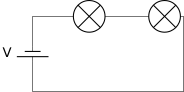
When resistors are connected in series, the same current flows through each, and the equivalent resistance is the sum of individual resistances:

In a parallel connection, the potential difference across each resistor is the same, and the reciprocal of the equivalent resistance is the sum of the reciprocals of individual resistances:
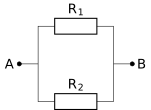
Series circuits are used to increase total resistance and provide a single path for current, whereas parallel circuits ensure that if one component fails, the others continue to function as they have independent paths.
📐Formulae
💡Examples
Problem 1:
A wire of resistance is stretched so that its length becomes three times its original length. If the volume remains constant, calculate the new resistance.
Solution:
Let initial length be and area be . Resistance . When stretched to , the area becomes (since Volume is constant). New resistance .
Explanation:
Stretching a wire increases its length and simultaneously decreases its cross-sectional area. Because is proportional to and inversely proportional to , the resistance increases by the square of the change in length.
Problem 2:
Compare the resistance of two wires of the same material: Wire A has length and radius , Wire B has length and radius .
Solution:
Resistance of Wire A: . Resistance of Wire B: .
Explanation:
Even though Wire B is twice as long (which increases resistance), its radius is doubled, making its area four times larger (which decreases resistance). The net effect is that Wire B has half the resistance of Wire A.
Problem 3:
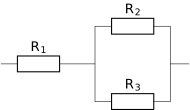
Calculate the equivalent resistance of the circuit shown, where , , and .
Solution:
First, calculate the parallel combination of and : So, . Now, the total resistance is the series sum of and :
Explanation:
We simplify the circuit by first solving the parallel branch ( and ) to find its single equivalent resistance, then adding that in series to .
Problem 4:
Determine the current flowing through a resistor when it is connected in parallel with a and resistor, all connected to a battery.
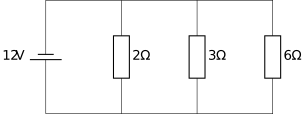
Solution:
In a parallel circuit, the voltage across each resistor is equal to the supply voltage. Thus, for each resistor. Using Ohm's law for the resistor ():
Explanation:
Because the resistors are in parallel, each resistor experiences the full potential difference of the battery. The current through a specific resistor is independent of the others.